NATIONAL HOMEOWNER RESOURCE
Geothermal FAQs
Practical answers about geothermal installation, costs, ground loops, heating and cooling, maintenance, troubleshooting, electrical issues, repair, replacement, and contractor selection.

Understanding geothermal
- What is a geothermal heat pump? It is a ground-source heat pump that moves heat between a home and the ground or suitable groundwater. Most home systems do not tap volcanic heat or create heat by burning fuel.
- Does geothermal heat and cool? Yes. A reversible refrigeration cycle collects ground-side heat in heating mode and rejects indoor heat to the ground side in cooling mode.
- Is geothermal appropriate in very cold or hot climates? It can be, but equipment, loop, airflow, humidity control, and backup strategy must be designed for local loads. Climate alone does not establish suitability.
- How is it different from an air-source heat pump? An air-source unit exchanges heat with outdoor air; a ground-source unit uses a water-based ground circuit. Ground-source operation can see steadier temperatures, while installation requires underground infrastructure.
- Does geothermal produce free energy? No. It moves renewable ground heat efficiently but still uses electricity for the compressor, pumps, blower, controls, and any auxiliary heat.
Installation, costs, and planning
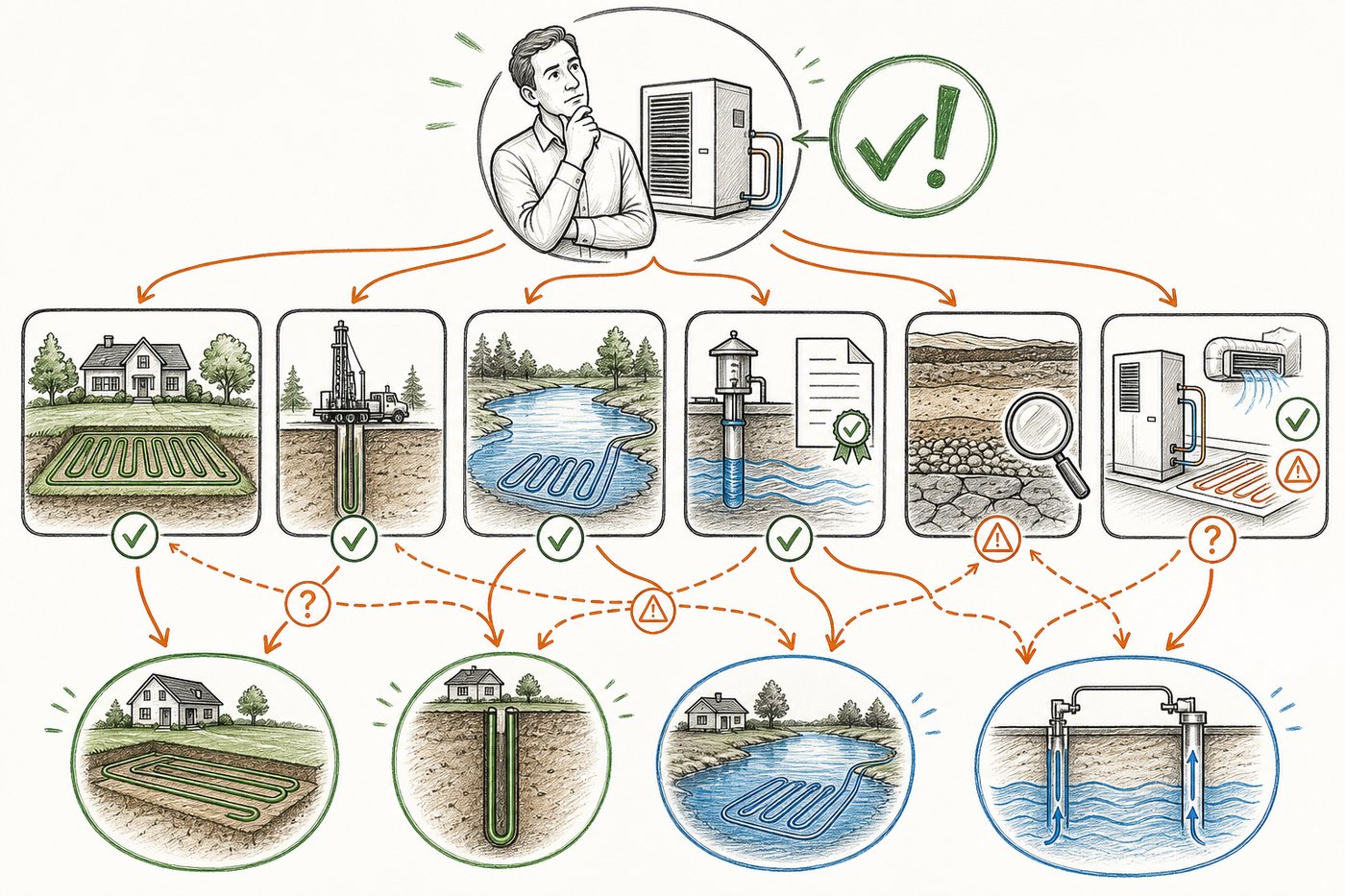
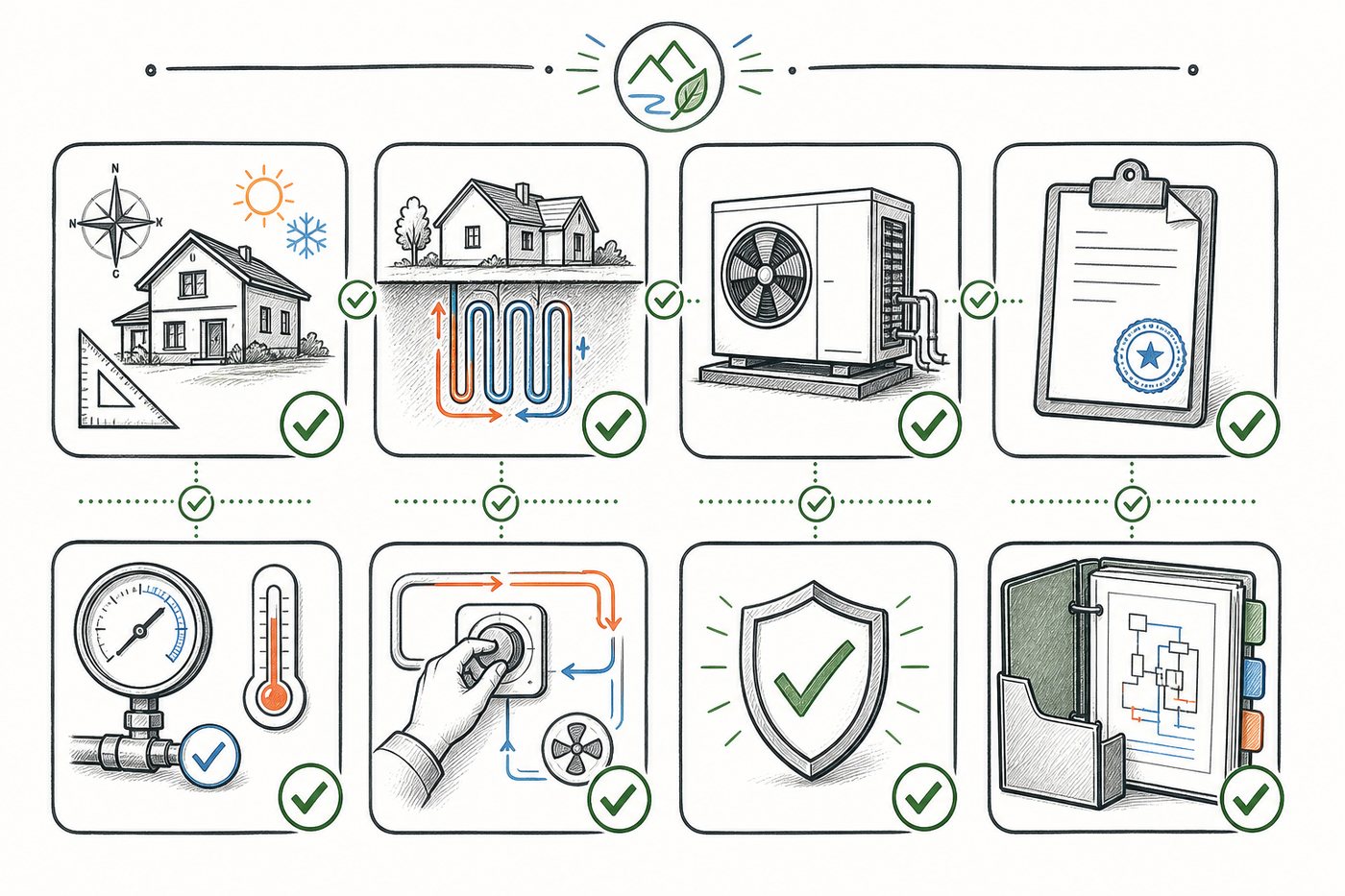
- What should an installer evaluate? Room-by-room loads, envelope, ducts or hydronics, electrical service, mechanical space, land and access, utilities, wells and septic systems, ground or water conditions, loop options, permits, backup heat, controls, and commissioning.
- Why do quotes vary so much? Equipment is only one component. Drilling or trenching, ground conditions, loop configuration, ducts, electrical work, permits, occupied-home work, access, and restoration are project-specific.
- Is a horizontal loop always cheaper? No. Accessible land can help, but trench quantity, wet or rocky ground, slopes, utilities, drainage, soil handling, and restoration can outweigh an apparent advantage.
- When is a vertical loop considered? Often on constrained sites or where trenching is undesirable. Drilling access, geology, groundwater protection, bore spacing, depth, grouting, spoils, and local rules remain important.
- Can a pond be used? Sometimes, but ownership, dimensions, seasonal conditions, access, environmental requirements, anchoring, and protection must be designed—not inferred from appearance.
- Can an open loop use my well? Only after water yield and quality, well construction, discharge, scaling or fouling, maintenance, and current rules are evaluated. An existing well is not automatic approval.
- What is the best way to compare quotes? Normalize loads, exact equipment, loop design, pumps, ducts, electrical work, backup heat, permits, ground work, restoration, commissioning, warranties, exclusions, and changed-condition terms.
Ground loops, replacement, and repair
- How long does a ground loop last? Properly designed and installed closed-loop piping can be long-lived, but no universal promise applies. Materials, fusion, pressure testing, grouting or backfill, ground movement, records, fluid, and operating conditions matter.
- Can a ground loop leak? Yes, although buried closed loops have few joints when well designed. Falling pressure, fluid loss, air, flow faults, or unexplained performance changes require testing; do not excavate or add fluid without diagnosis.
- What happens if a loop pump fails? The heat pump may lock out or lose capacity because ground-side flow is inadequate. Record the fault, stop repeated resets, and call a qualified technician to test power, controls, pump operation, flow, and the underlying cause.
- Can I reuse a ground loop when replacing the heat pump? Possibly. Verify layout, size, material, pressure integrity, flow, pumping, fluid condition, records, and compatibility before selecting new equipment.
- Does an old heat pump failure mean the loop must be replaced? No. Indoor equipment, controls, pumps, fluid, flow, and the loop should be evaluated separately. Complete loop replacement without diagnosis is a warning sign.
- When does an older geothermal heat pump need replacement? Consider measured condition, repair history, compressor and heat-exchanger condition, refrigerant and parts support, efficiency, controls, comfort, and compatibility with reusable infrastructure. Age alone is not a diagnosis.
- Should a technician keep replacing faulted parts? Repeated parts replacement without verifying airflow, water flow, sensors, controls, electrical supply, and fault history may miss the root cause. Ask for measured findings.
No heat, no cooling, and thermostat problems
- What should I do if my geothermal heat pump stops working? Confirm normal thermostat settings, check the accessible filter and registers, record fault codes, and note whether the thermostat, blower, and pumps appear active. If a breaker tripped, do not keep resetting it; call for service.
- What should I check if the thermostat is on but the system is not running? Confirm the mode, setpoint, schedule, battery if applicable, and normal equipment service switch. A delay after a setting change may be intentional. If it remains off, call a professional rather than bypassing controls.
- Why is the system blowing cold air in heating mode? Heat-pump supply air can feel cooler than furnace air, but wrong mode, low airflow, compressor or loop faults, controls, or backup operation can cause a real problem. Compare room temperature and supply behavior, then seek diagnosis if the home loses temperature.
- Why is it blowing warm air in cooling mode? Check mode and setpoint and allow for an intentional restart delay. If airflow continues without cooling, the compressor, loop flow, controls, or refrigerant circuit may need professional testing.
- Why is the house not reaching the thermostat setting? Loads may exceed current capacity, or airflow, ducts, loop flow, equipment stages, sensors, controls, auxiliary heat, or the building envelope may be involved. A technician should measure rather than guess.
- Why does the thermostat display differ from the room? Location, sunlight, drafts, calibration, remote sensors, schedules, zoning, or control faults may contribute. Do not move or rewire controls without documentation.
- What do common fault or error conditions mean? Meanings are model-specific. Photograph the exact code and time, consult the homeowner manual, and give the record to the technician. Do not repeatedly reset a recurring lockout.
Electrical and backup heat issues
- What should I do if the geothermal system trips a circuit breaker? Leave it off after a repeated trip and call a qualified professional or electrician. One trip may have several causes; a breaker is a safety device, not an operating switch.
- Why does the breaker trip repeatedly? Possible causes include equipment, pump, blower, auxiliary heat, wiring, connection, or breaker faults. Do not open an electrical panel, install a larger breaker, or defeat protection.
- Why is auxiliary or backup heat running frequently? Very cold weather may trigger designed use, but thermostat setup, staging, load, airflow, loop performance, sensor faults, or equipment problems can also increase operation. Frequent use warrants review because resistance heat can materially raise demand.
- Can I disable auxiliary heat to lower bills? Do not defeat safety or configured backup operation. Ask a qualified technician to verify the load, capacity, controls, electrical system, and reason for operation before changing strategy.
- What if I smell burning or see smoke? Use normal controls to turn the system off only if safe, leave the area as conditions require, and contact emergency services or a qualified electrician/HVAC professional. Do not remove covers to investigate energized equipment.
Runtime, energy use, and cycling
- Why is my geothermal system running continuously? Long cycles can be normal during demanding weather, especially with variable equipment. A dirty filter, duct restriction, changed load, low loop flow, incorrect staging, disabled capacity, or equipment fault can also be responsible.
- Why did my energy usage suddenly increase? Compare weather and rates, then consider auxiliary heat, thermostat changes, pump or blower operation, filter and airflow, well-pump use on open loops, loop or equipment faults, and unrelated household loads. Use interval data and service measurements where possible.
- Why is the system short cycling? Oversizing, thermostat location, zoning, airflow restrictions, control settings, sensor issues, rapid fault resets, or equipment faults can cause short cycles. Repeated cycling needs professional diagnosis because it can reduce comfort and stress components.
- Is a fixed savings percentage realistic? No. Results depend on the prior system, home loads, weather, rates, controls, ducts, pumps, backup heat, maintenance, and behavior. Ask for dated assumptions behind estimates.
Water, condensation, noise, and airflow
- What should I do if I see water around the unit? Turn cooling off through normal controls if water threatens property or electrical components, check only an accessible drain or pan without opening equipment, and call for service. Condensate blockage, leaks, freezing, or unrelated plumbing can be involved.
- Does water near the unit prove the ground loop leaks? No. Closed-loop fluid, condensate, domestic water, drain, humidifier, or nearby plumbing can look similar. Avoid contact with unknown fluid and have the source identified.
- Why is airflow weak? Check an accessible filter and open registers. A dirty coil, blower problem, restrictive duct, closed damper, zoning issue, or high static pressure requires professional measurement.
- Why are some rooms uncomfortable? Duct leakage, return paths, balancing, zoning, envelope differences, sun exposure, changed use, or load assumptions may be involved. Increasing equipment size without diagnosing distribution can make cycling worse.
- Why is the system making a new or unusual noise? Note whether it comes from the compressor, blower, pump, piping, ducts, or controls. Grinding, arcing, severe vibration, banging, or rapidly worsening noise calls for prompt service; do not remove covers.
- Why do pipes or pumps sound like water or air? Air, flow, pressure, pump, valve, or fluid issues may be involved. Loop purging and fluid work require proper equipment and qualified service.
Maintenance and contractor selection
- What maintenance can homeowners safely perform? Follow the manual for accessible filter care, keep registers and returns clear, maintain space around the unit, observe the condensate path, use normal thermostat controls, and record faults, noise, water, and energy changes.
- What belongs in professional maintenance? As appropriate: airflow and static pressure, condensate, electrical connections and components, controls and staging, refrigeration, pumps, loop flow or pressure, fluid condition, auxiliary heat, and fault history.
- How often should service occur? Follow the equipment and installer documentation and adjust for system type, filter loading, water quality, history, and local conditions. A generic interval does not replace model-specific guidance.
- How do I choose a repair contractor? Ask about geothermal diagnosis, your loop type and manufacturer, airflow and water-side measurements, controls, parts access, written findings, and whether the contractor services both equipment and ground-side components or coordinates the responsible trade.
- When should I stop troubleshooting and call a professional? Call when safe basic checks do not restore normal operation, a fault recurs, comfort or energy use changes materially, water persists, airflow is weak, a breaker trips, auxiliary heat is excessive, or any electrical, refrigerant, loop, drilling, or buried repair is indicated.
Safe troubleshooting boundary
Homeowner checks should stay observational and limited to normal user controls: confirm the thermostat mode and setpoint, replace or clean an accessible filter according to the manufacturer, check that registers are open, look for a tripped service switch that is intended for normal use, record displayed fault codes, and note when the symptom occurs.
Do not open an electrical panel, remove energized equipment covers, defeat a breaker or safety switch, work on a refrigerant circuit, handle hazardous voltage, add loop fluid, or attempt drilling or buried-loop repair. Stop if you smell burning, see smoke, hear arcing, find significant flooding, encounter exposed wiring, or a breaker trips repeatedly. Turn equipment off only through normal controls if safe, keep people away, and call a qualified geothermal or HVAC professional or electrician as appropriate.