CONTRACTOR SELECTION
How to Find a Qualified Geothermal Installer
Compare geothermal contractors on design evidence, ground-loop responsibility, measured commissioning, warranties, and service—not just equipment brands or the lowest price.
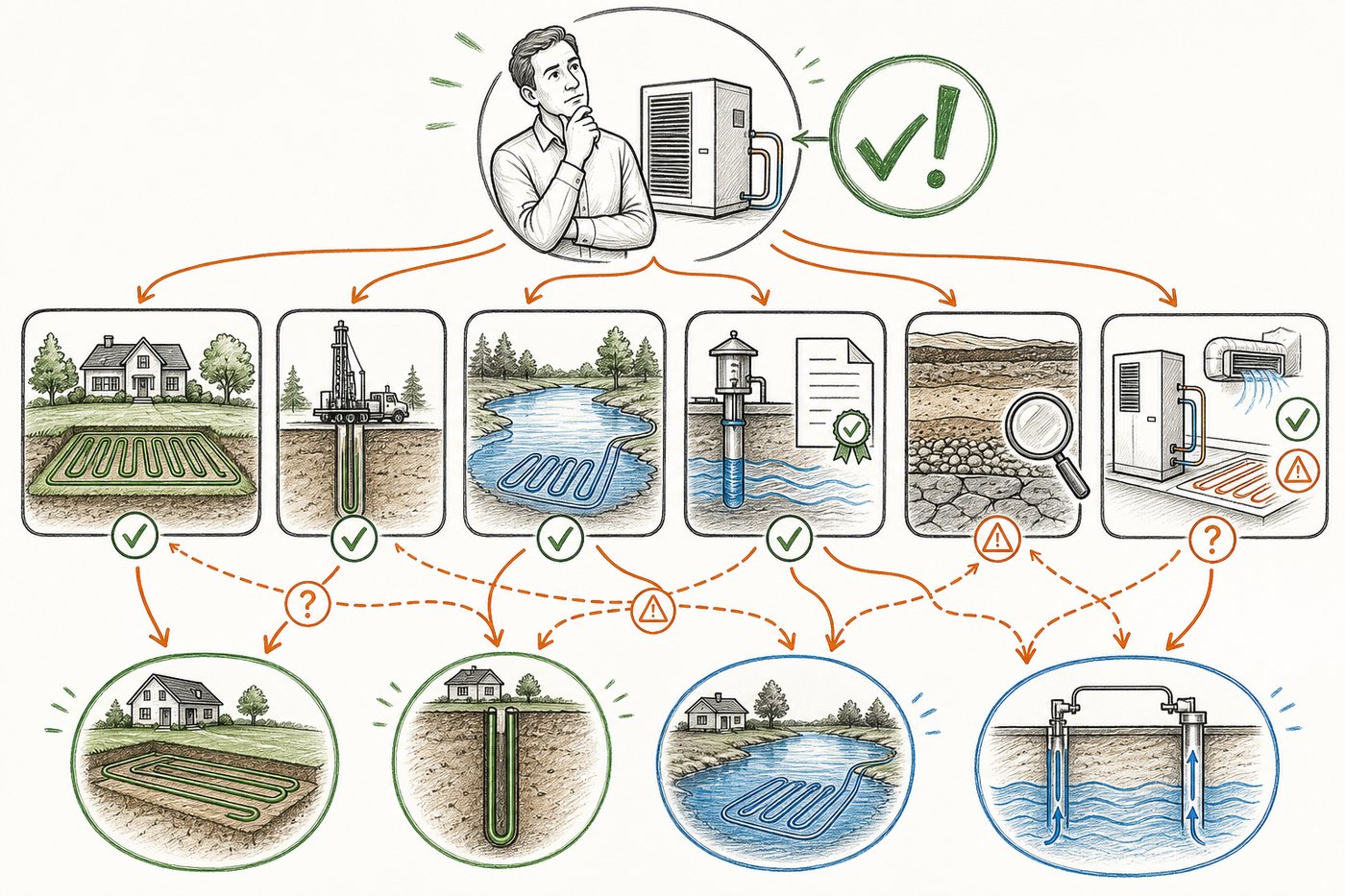


Start with geothermal-specific experience
General HVAC experience matters, but geothermal adds ground heat exchangers, circulation, drilling or excavation, fusion, flushing, antifreeze where applicable, and water-side diagnostics. Ask how many comparable closed-loop, open-loop, horizontal, vertical, retrofit, replacement, or new-construction projects the team has completed—and which parts were performed by subcontractors.
Verify licenses, registrations, insurance, permits, and manufacturer requirements that apply to the actual work and jurisdiction. A badge or training course can be useful, but it does not replace references, design quality, competent field staff, or accountability for the complete system.
Require a defensible design
- A room-by-room load calculation based on the actual envelope and local design conditions, not square footage or the old unit alone.
- Equipment capacity, stages or modulation, airflow or hydronic delivery, humidity strategy, controls, and auxiliary-heat assumptions connected to the calculated loads.
- A ground-loop design explaining configuration, usable land, ground or water assumptions, pipe, bore or trench layout, flow, pressure drop, pumping, fluid, and testing.
- A duct evaluation that checks airflow, returns, static pressure, leakage, room balance, and known comfort problems instead of assuming existing ducts are adequate.
- An electrical review covering circuits, pumps, controls, auxiliary heat, disconnects, panel capacity, permits, and any utility coordination.
Know who owns every part of the project
Many strong geothermal projects use drilling, excavation, electrical, or controls subcontractors. The red flag is not subcontracting; it is unclear responsibility. Get the business names and roles in writing. Determine who designed the loop, marks utilities, obtains permits, manages changed ground conditions, fuses and pressure-tests pipe, handles spoils and restoration, starts the equipment, and returns if a fault crosses trade boundaries.
Ask whether the HVAC contractor and driller have worked together before, what records move between them, and who resolves a dispute about loop flow, equipment operation, or site damage. The homeowner should not be forced to diagnose which contractor is responsible after installation.
Compare complete proposals
Normalize scope before comparing price. Record exact models; loop configuration and quantity; pumps and controls; ducts; electrical work; auxiliary heat; water-heating options; permits; demolition; drilling or excavation; grout, backfill, and fluid; testing; spoils; landscaping or pavement restoration; startup; documentation; and exclusions. Separate fixed amounts from allowances and identify change-order triggers.
Technically different proposals are not automatically wrong. Ask each contractor to explain why its load, equipment capacity, loop length, bore depth, pump selection, or backup strategy differs. Favor measured assumptions and transparent calculations over confidence without evidence.
Commissioning, warranties, and long-term service
- Request commissioning records appropriate to the design: airflow, static pressure, supply and return temperatures, loop entering and leaving temperatures, flow or pressure, pump operation, controls, auxiliary heat, condensate, and fault history.
- Ask for final loop drawings, bore or trench records, pressure tests, fluid information, control settings, equipment data, permits, inspections, and homeowner instructions.
- Compare equipment, labor, loop, drilling, pump, controls, and restoration warranties separately. Confirm duration, exclusions, transfer terms, registration duties, and the responsible company.
- Ask who provides routine maintenance and diagnosis after the sale, whether replacement parts and manufacturer support are practical locally, and how service history is retained.
- Call recent and older references with comparable homes and loop types. Ask about design changes, site care, comfort, electric use versus expectations, documentation, and response when a problem appeared.
Questions to ask finalists
- Who performed the load calculation and loop design, and may I see the reports before signing?
- What site facts are measured, what is assumed, and what could change the price?
- Why is this equipment and loop configuration appropriate, and what alternatives were rejected?
- When should backup heat run, and how will controls and electrical capacity be verified?
- Which permits and inspections apply, and who obtains and closes them?
- Which employees and subcontractors perform each trade, and who owns whole-system performance?
- What measured startup results and final records will I receive?
- What happens if the home misses the thermostat setting, energy use is unexpectedly high, or a recurring loop or compressor fault appears?
Warning signs
Be cautious with no load calculation, vague model numbers, unexplained loop footage, automatic reuse of an old loop, guaranteed savings, pressure to sign, verbal-only warranties, missing permits, no commissioning plan, no service path, or a proposal that ignores ducts, electrical service, restoration, and backup heat. Use the geothermal red-flags guide for a more complete checklist.