GEOTHERMAL FUNDAMENTALS
What Is a Geothermal Heat Pump?
A geothermal heat pump heats and cools a home by moving heat between the building and the ground. Learn what the indoor equipment, ground loop, controls, and backup heat actually do—and what an installer must evaluate before recommending a system.

How geothermal heating and cooling works
A residential geothermal heat pump is also called a ground-source heat pump. It does not burn fuel to create most of its heat. Instead, a refrigeration cycle moves heat between the home and a water-based ground-side circuit. The earth below the shallow surface changes temperature more slowly than outdoor air, giving the heat pump a comparatively stable place to collect heat in winter and reject heat in summer.
The system is reversible. In heating mode, fluid returning from the ground carries low-temperature heat to the indoor unit. The refrigerant circuit raises that heat to a useful temperature and the air handler or hydronic distribution system delivers it indoors. In cooling mode, the cycle reverses: heat and moisture are removed from indoor air, and the ground circuit carries the rejected heat away.
Geothermal is not the same as using naturally hot underground water or steam. Most home systems rely on ordinary ground temperatures and a heat pump. The ground loop exchanges heat; it does not usually deliver hot water directly to the living space.
The parts of a residential system
- Indoor heat-pump equipment contains the compressor, refrigerant heat exchangers, controls, and—on forced-air systems—the blower. Packaged and split arrangements are both possible.
- The ground heat exchanger is buried piping or an approved groundwater arrangement. Closed loops circulate water or a specified antifreeze solution; they do not consume groundwater during normal operation.
- A circulation pump or pump module moves fluid through a closed loop. Flow, pressure, fluid condition, and pumping energy are part of system performance.
- Ducts, registers, returns, or a compatible hydronic distribution system move useful heating and cooling through the home. Geothermal cannot correct undersized, leaky, or poorly balanced distribution by itself.
- Thermostats and controls coordinate compressor stages, pumps, blower operation, humidity settings, and auxiliary heat. Incorrect setup can make good equipment perform poorly.
Ground-loop choices
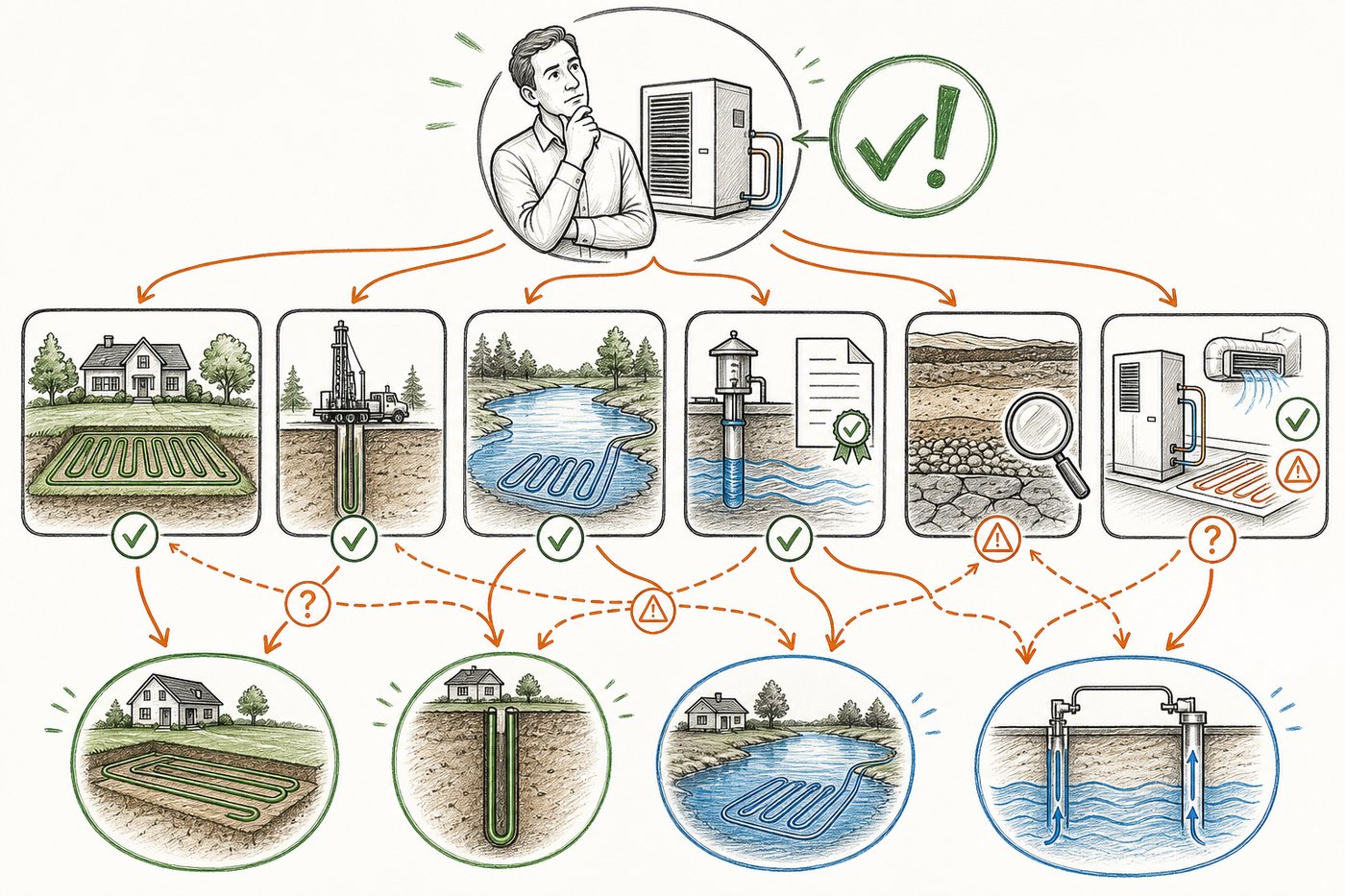
Horizontal closed loops use trenches and generally need accessible land with suitable soil, grading, drainage, and restoration conditions. Vertical closed loops place pipe in drilled boreholes and can fit smaller sites, but drilling access, geology, groundwater protection, bore spacing, grouting, and spoils handling matter. A pond or lake loop may be possible only where the water body, ownership, depth, seasonal conditions, environmental rules, access, and anchoring are suitable.
An open-loop system draws suitable groundwater through the heat pump and discharges it through an approved method. Water quantity, quality, scaling or fouling potential, well performance, discharge rules, and long-term maintenance must be evaluated. A nearby well is not proof that an open loop is appropriate or permitted.
There is no universally best loop. The proposal should connect the selected configuration to the building load, measured or defensible ground assumptions, available area, drilling or excavation access, utilities, wells and septic components, permitting, pressure testing, and restoration scope.
Heating, cooling, backup heat, and hot water
In heating mode, supply air from a heat pump may feel less intensely hot than air from a combustion furnace, even while the system is maintaining the thermostat setting. Long, steady operation can be normal. In cooling mode, correct airflow and runtime are important for both temperature and moisture removal.
Some systems include electric resistance auxiliary or backup heat; other projects use a separate backup source. Backup heat can provide capacity during unusual loads or a fault, but frequent operation can signal control settings, sizing, airflow, loop, or equipment problems. The design should state when backup is expected to run, how it is sized and staged, and whether the electrical service can support it.
Some geothermal units can assist with domestic hot water through a desuperheater or dedicated water-heating arrangement. Output depends on system type and operation; it should not be described as unlimited free hot water. Tank configuration, controls, plumbing, water quality, code requirements, and the primary water-heating plan need project-specific design.
Understanding efficiency terms
Heating efficiency may be expressed as coefficient of performance, or COP: useful heat delivered compared with electricity consumed under stated test conditions. Cooling efficiency may be expressed as EER. Published ratings help compare equipment, but whole-system results also depend on loop temperatures and flow, pump and blower energy, duct performance, staging, controls, backup heat, climate, and occupant settings.
An air-source heat pump exchanges heat with outdoor air and normally uses an outdoor coil and fan. A ground-source system exchanges heat with the ground-side circuit. The steadier heat source or sink can improve operating conditions, but the underground work makes design, installation, and first cost more involved. Either technology can be a sound choice when it fits the home, site, contractors, and budget.
Is every home suitable?
Geothermal can work in new construction and many retrofits, including cold and hot climates, but suitability is not established by climate alone. A constrained lot, difficult access, unknown geology, protected land, inadequate wells, incompatible distribution, limited electrical capacity, or a budget that cannot support the ground work may change the answer. A well-designed air-source heat pump or another HVAC solution may be more practical for some homes.
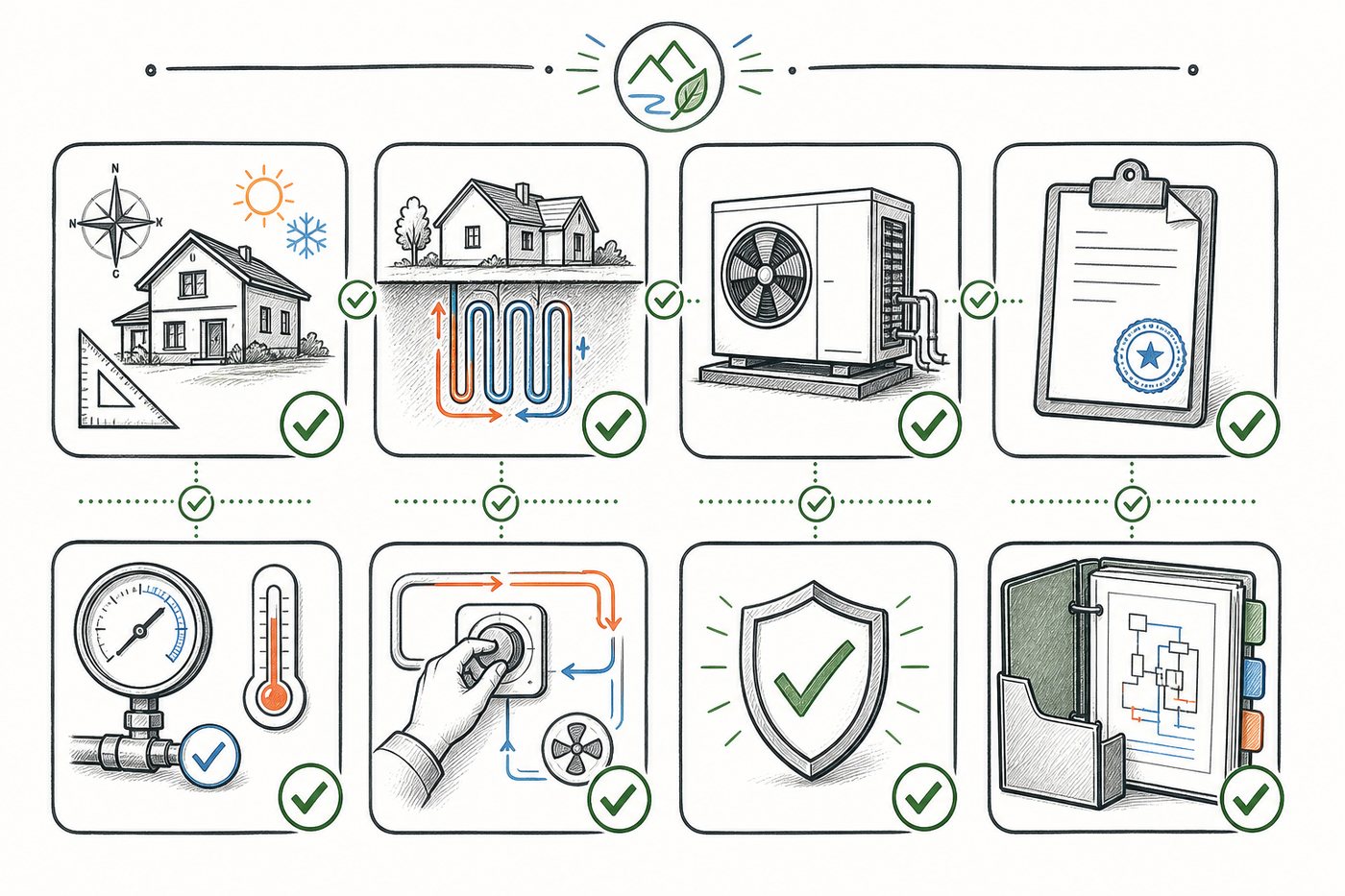
A qualified evaluation should include a room-by-room load calculation; envelope and comfort history; ducts or hydronic distribution; electrical service; mechanical space; usable land and access; utilities, wells, septic systems, drainage, and landscaping; ground or water conditions; loop options; permits; backup heat; controls; service access; and commissioning. The result should be a documented system proposal, not a rule of thumb based only on square footage or the old unit.