Alabama condition guide
Alabama High Water Table Geothermal Installation Guide
A homeowner-focused guide to how high water table, wet sites, floodplains, groundwater, water quality, drainage, and discharge/return questions can affect geothermal installation planning in Alabama.
High water table conditions can make a geothermal proposal more complex because water affects both construction logistics and long-term system decisions. A wet yard, nearby creek, floodplain, shallow groundwater, or existing well may influence trenching, drilling, water-source screening, equipment placement, drainage, erosion control, and permitting. None of those conditions automatically rule geothermal in or out, but they should be evaluated before a homeowner accepts a proposal.
This page builds on the national geothermal installation guide and the Alabama geothermal installation guide. It focuses on water-table and wet-site questions for Alabama homeowners. For contractor comparisons, use the Alabama geothermal installers directory.
Quick-scan summary for Alabama homeowners
Guide navigation
Alabama high water table map / diagram
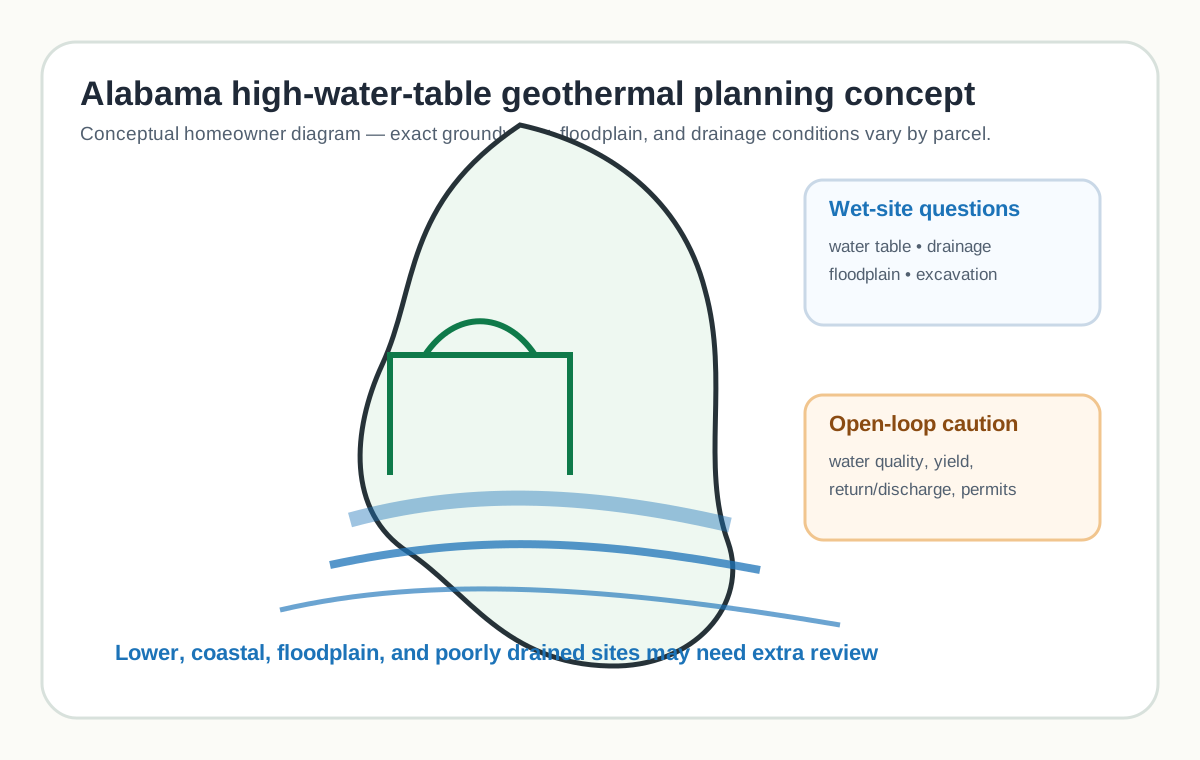
Why high water table changes Alabama geothermal planning
High water table matters because geothermal work often involves underground construction. Saturated soil can affect trench stability, drilling support, mud management, spoils handling, erosion control, and restoration. It can also raise questions about whether indoor or outdoor equipment should be protected from flooding or chronic moisture exposure.
Water conditions also affect loop-type screening. Closed-loop systems may still be viable, but installers should explain how wet excavation, grouting, pressure testing, and restoration will be handled. Pond/lake systems require a suitable water body, not just a wet property. Open-loop systems require the most caution because water quantity, water quality, withdrawal, return or discharge, maintenance, and permitting all matter.
Alabama homeowners should not treat statewide generalizations as a design. Conditions can differ between coastal plain properties, river bottoms, low suburban lots, rural wells, and upland sites with perched wet areas. A credible proposal should identify what can be verified before work begins and what remains a field condition to manage.
The 13-step geothermal installation process adapted for Alabama high water table sites
1. Project goals and home suitability

For high-water-table or wet-site projects, this step should identify water-table, drainage, floodplain, and equipment-location concerns early. A wet-looking yard does not automatically choose a geothermal design, and a dry-looking yard does not prove groundwater questions are irrelevant. The installer should explain what is known, what must be verified, and what will be documented.
Ask: How will high groundwater, seasonal wetness, floodplain location, or drainage change this step? Red flags: casual open-loop promises, no water-quality review, no drainage plan, no permitting explanation, or no written commissioning records.
2. Load calculation and energy analysis
For high-water-table or wet-site projects, this step should tie loop and water-source decisions to the calculated load, not to visible wetness. A wet-looking yard does not automatically choose a geothermal design, and a dry-looking yard does not prove groundwater questions are irrelevant. The installer should explain what is known, what must be verified, and what will be documented.
Ask: How will high groundwater, seasonal wetness, floodplain location, or drainage change this step? Red flags: casual open-loop promises, no water-quality review, no drainage plan, no permitting explanation, or no written commissioning records.
3. Site evaluation

For high-water-table or wet-site projects, this step should review low areas, flood maps, drainage paths, wells, septic, surface water, and access. A wet-looking yard does not automatically choose a geothermal design, and a dry-looking yard does not prove groundwater questions are irrelevant. The installer should explain what is known, what must be verified, and what will be documented.
Ask: How will high groundwater, seasonal wetness, floodplain location, or drainage change this step? Red flags: casual open-loop promises, no water-quality review, no drainage plan, no permitting explanation, or no written commissioning records.
4. Loop-type screening

For high-water-table or wet-site projects, this step should screen loop types cautiously, especially open-loop or pond/lake ideas. A wet-looking yard does not automatically choose a geothermal design, and a dry-looking yard does not prove groundwater questions are irrelevant. The installer should explain what is known, what must be verified, and what will be documented.
Ask: How will high groundwater, seasonal wetness, floodplain location, or drainage change this step? Red flags: casual open-loop promises, no water-quality review, no drainage plan, no permitting explanation, or no written commissioning records.
5. Equipment and system design review
For high-water-table or wet-site projects, this step should keep equipment location, condensate, and flood exposure in the design conversation. A wet-looking yard does not automatically choose a geothermal design, and a dry-looking yard does not prove groundwater questions are irrelevant. The installer should explain what is known, what must be verified, and what will be documented.
Ask: How will high groundwater, seasonal wetness, floodplain location, or drainage change this step? Red flags: casual open-loop promises, no water-quality review, no drainage plan, no permitting explanation, or no written commissioning records.
6. Proposal review and scope definition
For high-water-table or wet-site projects, this step should state water testing, permitting, discharge/return, dewatering, and restoration responsibilities. A wet-looking yard does not automatically choose a geothermal design, and a dry-looking yard does not prove groundwater questions are irrelevant. The installer should explain what is known, what must be verified, and what will be documented.
Ask: How will high groundwater, seasonal wetness, floodplain location, or drainage change this step? Red flags: casual open-loop promises, no water-quality review, no drainage plan, no permitting explanation, or no written commissioning records.
7. Permits, utility locating, and schedule planning
For high-water-table or wet-site projects, this step should coordinate permits, utility locating, weather timing, floodplain questions, and water rules. A wet-looking yard does not automatically choose a geothermal design, and a dry-looking yard does not prove groundwater questions are irrelevant. The installer should explain what is known, what must be verified, and what will be documented.
Ask: How will high groundwater, seasonal wetness, floodplain location, or drainage change this step? Red flags: casual open-loop promises, no water-quality review, no drainage plan, no permitting explanation, or no written commissioning records.
8. Drilling, trenching, or water-source preparation

For high-water-table or wet-site projects, this step should adapt drilling, trenching, or water-source preparation to saturated soil and groundwater uncertainty. A wet-looking yard does not automatically choose a geothermal design, and a dry-looking yard does not prove groundwater questions are irrelevant. The installer should explain what is known, what must be verified, and what will be documented.
Ask: How will high groundwater, seasonal wetness, floodplain location, or drainage change this step? Red flags: casual open-loop promises, no water-quality review, no drainage plan, no permitting explanation, or no written commissioning records.
9. Loop installation and field assembly

For high-water-table or wet-site projects, this step should protect loop assembly from floating trenches, unstable excavations, and undocumented field changes. A wet-looking yard does not automatically choose a geothermal design, and a dry-looking yard does not prove groundwater questions are irrelevant. The installer should explain what is known, what must be verified, and what will be documented.
Ask: How will high groundwater, seasonal wetness, floodplain location, or drainage change this step? Red flags: casual open-loop promises, no water-quality review, no drainage plan, no permitting explanation, or no written commissioning records.
10. Fusion, flushing, pressure testing, and fluid setup

For high-water-table or wet-site projects, this step should document flushing, pressure testing, water quality, flow, and fluid setup before concealment. A wet-looking yard does not automatically choose a geothermal design, and a dry-looking yard does not prove groundwater questions are irrelevant. The installer should explain what is known, what must be verified, and what will be documented.
Ask: How will high groundwater, seasonal wetness, floodplain location, or drainage change this step? Red flags: casual open-loop promises, no water-quality review, no drainage plan, no permitting explanation, or no written commissioning records.
11. Indoor equipment and distribution integration

For high-water-table or wet-site projects, this step should locate indoor equipment and drains away from avoidable wet-site problems. A wet-looking yard does not automatically choose a geothermal design, and a dry-looking yard does not prove groundwater questions are irrelevant. The installer should explain what is known, what must be verified, and what will be documented.
Ask: How will high groundwater, seasonal wetness, floodplain location, or drainage change this step? Red flags: casual open-loop promises, no water-quality review, no drainage plan, no permitting explanation, or no written commissioning records.
12. Controls, startup, and commissioning

For high-water-table or wet-site projects, this step should commission loop temperatures, flow, controls, condensate, and water-source details where relevant. A wet-looking yard does not automatically choose a geothermal design, and a dry-looking yard does not prove groundwater questions are irrelevant. The installer should explain what is known, what must be verified, and what will be documented.
Ask: How will high groundwater, seasonal wetness, floodplain location, or drainage change this step? Red flags: casual open-loop promises, no water-quality review, no drainage plan, no permitting explanation, or no written commissioning records.
13. Homeowner walkthrough, documentation, and maintenance expectations
For high-water-table or wet-site projects, this step should hand over as-built records, water records, maintenance expectations, and site-protection notes. A wet-looking yard does not automatically choose a geothermal design, and a dry-looking yard does not prove groundwater questions are irrelevant. The installer should explain what is known, what must be verified, and what will be documented.
Ask: How will high groundwater, seasonal wetness, floodplain location, or drainage change this step? Red flags: casual open-loop promises, no water-quality review, no drainage plan, no permitting explanation, or no written commissioning records.
Loop type implications for Alabama high-water-table sites
High water table and wet-site conditions do not make one loop type always best. They change the risk questions around excavation, groundwater protection, water quality, discharge or return, floodplain exposure, and maintenance. Ask the installer to explain which options may be relevant and why other options were ruled out.
Horizontal closed loop

Whether it may be relevant for this condition: Horizontal closed loop may be relevant when usable land exists and wet conditions can be managed, but saturated trenches, unstable sidewalls, buoyancy, drainage, and restoration must be considered.
Site requirements: The installer should evaluate water-table depth or seasonal indicators, floodplain status, drainage, soil stability, utilities, septic and wells, access, water quality where relevant, and local permitting. Water-source options require a separate water review.
Strengths: This option can be considered when the site supports it and the proposal explains installation logistics, testing, and maintenance clearly.
Limitations: Wet conditions can complicate trenching, drilling support, routing, dewatering, erosion control, and restoration. Open-loop and standing-column ideas add water-quality, withdrawal, return/discharge, and maintenance questions.
Alabama-specific considerations, homeowner questions, and red flags: Lower, coastal, floodplain, poorly drained, and stream-adjacent Alabama properties may need extra review. Ask who verifies water conditions and rules. Red flags include assuming water availability equals suitability, ignoring floodplain or drainage questions, or skipping written water test documentation.
Vertical closed loop

Whether it may be relevant for this condition: Vertical closed loop may be relevant where surface wetness, limited land, or restoration concerns make broad trenching less attractive. Drilling access, grouting, spoils, and groundwater protection still matter.
Site requirements: The installer should evaluate water-table depth or seasonal indicators, floodplain status, drainage, soil stability, utilities, septic and wells, access, water quality where relevant, and local permitting. Water-source options require a separate water review.
Strengths: This option can be considered when the site supports it and the proposal explains installation logistics, testing, and maintenance clearly.
Limitations: Wet conditions can complicate trenching, drilling support, routing, dewatering, erosion control, and restoration. Open-loop and standing-column ideas add water-quality, withdrawal, return/discharge, and maintenance questions.
Alabama-specific considerations, homeowner questions, and red flags: Lower, coastal, floodplain, poorly drained, and stream-adjacent Alabama properties may need extra review. Ask who verifies water conditions and rules. Red flags include assuming water availability equals suitability, ignoring floodplain or drainage questions, or skipping written water test documentation.
Pond/lake closed loop

Whether it may be relevant for this condition: Pond/lake closed loop may be relevant only if the water body is suitable in depth, ownership, seasonal stability, routing, environmental constraints, and protection from flood or storm damage.
Site requirements: The installer should evaluate water-table depth or seasonal indicators, floodplain status, drainage, soil stability, utilities, septic and wells, access, water quality where relevant, and local permitting. Water-source options require a separate water review.
Strengths: This option can be considered when the site supports it and the proposal explains installation logistics, testing, and maintenance clearly.
Limitations: Wet conditions can complicate trenching, drilling support, routing, dewatering, erosion control, and restoration. Open-loop and standing-column ideas add water-quality, withdrawal, return/discharge, and maintenance questions.
Alabama-specific considerations, homeowner questions, and red flags: Lower, coastal, floodplain, poorly drained, and stream-adjacent Alabama properties may need extra review. Ask who verifies water conditions and rules. Red flags include assuming water availability equals suitability, ignoring floodplain or drainage questions, or skipping written water test documentation.
Open-loop well system

Whether it may be relevant for this condition: Open-loop well system may be considered only after water quantity, water quality, permitted withdrawal, approved return or discharge, filtration, corrosion, scaling, and maintenance are reviewed.
Site requirements: The installer should evaluate water-table depth or seasonal indicators, floodplain status, drainage, soil stability, utilities, septic and wells, access, water quality where relevant, and local permitting. Water-source options require a separate water review.
Strengths: This option can be considered when the site supports it and the proposal explains installation logistics, testing, and maintenance clearly.
Limitations: Wet conditions can complicate trenching, drilling support, routing, dewatering, erosion control, and restoration. Open-loop and standing-column ideas add water-quality, withdrawal, return/discharge, and maintenance questions.
Alabama-specific considerations, homeowner questions, and red flags: Lower, coastal, floodplain, poorly drained, and stream-adjacent Alabama properties may need extra review. Ask who verifies water conditions and rules. Red flags include assuming water availability equals suitability, ignoring floodplain or drainage questions, or skipping written water test documentation.
Standing column well

Whether it may be relevant for this condition: Standing column well is a specialized regional/site-specific concept and should only be discussed where geology, groundwater behavior, well construction, water quality, and local rules support it.
Site requirements: The installer should evaluate water-table depth or seasonal indicators, floodplain status, drainage, soil stability, utilities, septic and wells, access, water quality where relevant, and local permitting. Water-source options require a separate water review.
Strengths: This option can be considered when the site supports it and the proposal explains installation logistics, testing, and maintenance clearly.
Limitations: Wet conditions can complicate trenching, drilling support, routing, dewatering, erosion control, and restoration. Open-loop and standing-column ideas add water-quality, withdrawal, return/discharge, and maintenance questions.
Alabama-specific considerations, homeowner questions, and red flags: Lower, coastal, floodplain, poorly drained, and stream-adjacent Alabama properties may need extra review. Ask who verifies water conditions and rules. Red flags include assuming water availability equals suitability, ignoring floodplain or drainage questions, or skipping written water test documentation.
Condition-specific site evaluation checklist
Water indicators
- Low areas, floodplain context, drainage paths, ditches, streams, ponds, and seasonal standing water.
- Existing wells, septic systems, well separation concerns, and water-quality questions.
Construction logistics
- Equipment access, wet-weather schedule, dewatering needs, spoils handling, erosion control, and restoration.
- Potential indoor equipment locations away from avoidable wet-site risks.
Permits and records
- Local drilling, excavation, floodplain, water withdrawal, discharge, or injection questions where relevant.
- Written testing, startup, water, and as-built documentation expectations.
Condition-specific proposal comparison checklist

| Proposal item | What a complete proposal should include | Why it matters for Alabama high water table sites | Questions to ask | Red flags |
|---|---|---|---|---|
| Water-table screening | Site observations, soil/water resources, floodplain or drainage notes. | Wet conditions change work methods. | What water conditions did you verify? | No wet-site review. |
| Loop selection | Reasoned comparison of closed-loop and water-source options. | Water presence does not choose the loop. | Why this loop here? | One-size-fits-all answer. |
| Open-loop review | Yield, water quality, return/discharge, approvals, filtration, maintenance. | Open-loop risk is water-specific. | Who tests and permits it? | No water test. |
| Construction plan | Dewatering, access, erosion, spoils, flood/rain delay, restoration. | Wet soil affects execution. | What happens after heavy rain? | No schedule contingency. |
| Commissioning | Pressure tests, flow/temperature readings, water records, homeowner handoff. | Hidden work must be documented. | What records will I receive? | No written startup data. |
Homeowner questions checklist
Load calculation
- How does the load determine the loop or water-source requirement?
Site evaluation
- What water-table, drainage, floodplain, well, septic, and access issues did you identify?
Loop type
- Which loop types may be relevant, and why were others ruled out?
Drilling/trenching/water-source work
- How will groundwater, wet soil, spoils, dewatering, discharge, and restoration be handled?
Indoor equipment
- Is the equipment location protected from avoidable moisture or flooding concerns?
Permits
- Who confirms drilling, water, discharge, floodplain, or injection requirements?
Testing and commissioning
- What loop, flow, pressure, temperature, and water-quality records will I receive?
Warranty
- What is covered if water conditions differ from assumptions?
Documentation
- Will I receive as-built loop and water-source records?
Red flags specific to high-water-table geothermal proposals

- Open-loop promised because the property is wet, without water testing.
- No discussion of discharge, return, injection, withdrawal, or local approval questions.
- No floodplain, drainage, wet-weather access, dewatering, or restoration plan.
- No pressure-test, flushing, water-quality, or startup documentation.
- Unsupported claim that one loop type is always best for high water table sites.
- DIY drilling, trenching, water-source, electrical, or loop-fusion suggestions.
How to use this wet-site guide during contractor conversations
Wet-site conversations should be specific. Ask the installer to separate three different issues: construction logistics, loop performance, and water-source legality. A yard that is wet after rain may create equipment-access and restoration problems without being suitable for an open-loop system. A well on the property may be useful for domestic water but still unsuitable for geothermal withdrawal or discharge. A floodplain may affect placement and scheduling even if a closed loop remains possible.
Homeowners should ask for written assumptions. The proposal should say what water information was reviewed, what testing is required, who coordinates permits, where discharge or return water would go if relevant, how wet-weather work is handled, and what records the homeowner receives. This turns vague groundwater language into a scope that can be compared.
Ask about maintenance as well as installation. Water-source systems can involve filtration, scaling, corrosion, fouling, pump service, and water-quality monitoring. Closed loops avoid many water-quality issues, but still need pressure testing, flushing, and as-built documentation. The better proposal explains the tradeoffs without pretending that wet ground automatically makes one solution best.
If a contractor cannot explain the difference between groundwater presence, groundwater quality, and permitted groundwater use, pause before signing. Those are different questions. The safest installer is usually the one who names the uncertainties and explains how they will be resolved before construction begins.
For wet Alabama properties, the most useful proposal is one that distinguishes what is known today from what must be verified before construction. Water level, water quality, drainage, flood exposure, and discharge or return requirements are not interchangeable. A homeowner should be able to read the scope and understand which party is responsible for each verification step.
Wet sites also require clear construction boundaries. The proposal should explain whether the crew expects temporary water control, whether trenching or drilling support work may be delayed after heavy rain, where spoils will be placed, and how disturbed areas will be stabilized. If the home is near a floodplain or low drainage path, ask whether equipment placement, electrical work, or service access needs extra review.
Water-source ideas deserve a separate decision trail. The installer should not blend domestic-well assumptions, pond-loop assumptions, and open-loop geothermal assumptions into one vague statement. Ask for water-quality testing, yield assumptions, discharge or return details, and local approval responsibilities in writing before treating a water-source option as viable.
Closed-loop systems still need water-aware planning. Horizontal trenches, vertical headers, bore grouting, pressure testing, and restoration can all be affected by saturated soil or shallow groundwater. A good installer explains how the closed loop will be protected and verified before the yard is restored.
The final homeowner documents should include the loop or water-source layout, testing records, startup readings, and any water-related maintenance expectations. Those records matter years later when the property owner adds drainage work, landscaping, fencing, wells, septic changes, or outbuildings.
Wet-site design details homeowners should not skip
High water table questions often begin outside, but they can affect the whole project schedule. A wet site can slow equipment access, change where spoils are placed, require extra erosion control, or make restoration more sensitive. Homeowners should ask whether the proposal assumes dry-weather access, whether the crew will use mats or driveway protection, and whether heavy equipment will avoid septic fields, wells, drainage swales, and low areas that rut easily.
For horizontal closed-loop proposals, the most important wet-site questions involve trench stability, standing water, pipe placement, backfill, and settlement. A contractor should be able to explain what happens if groundwater enters the trench, whether work pauses after heavy rain, and how the loop will be protected before backfill. The homeowner should also ask how the yard will be graded so disturbed trenches do not become new drainage channels.
For vertical closed-loop proposals, water-table issues are different. The work may avoid long trenches, but drilling still requires access, spoils handling, bore sealing or grouting, and header routing. Homeowners should ask whether groundwater conditions change drilling methods, whether local requirements affect bore construction, and what records will be provided after the boreholes are complete.
For pond or lake ideas, the water body must be evaluated as a heat-exchange resource, not treated as decorative water on the property. Ask about depth, seasonal stability, sediment, ownership, environmental limitations, routing, flood debris, and future pond use. A pond that is convenient for livestock, irrigation, or stormwater management may not automatically be appropriate for a geothermal loop.
For open-loop systems, the homeowner should expect the most documentation. Water quality can affect scaling, corrosion, filtration, and maintenance. Water quantity can affect pumping assumptions and reliability. Return or discharge rules can affect whether the concept is allowed at all. The installer should identify who performs testing, who interprets the results, who confirms approvals, and what maintenance the homeowner should expect.
Floodplain context should be handled carefully. A homeowner does not need the installer to make legal determinations beyond their role, but the proposal should identify whether floodplain or drainage information must be checked before placing equipment, routing lines, or planning access. Indoor equipment should not be located where chronic moisture or flood risk can be avoided through better planning.
Good wet-site proposals separate facts from assumptions. A fact might be an observed drainage swale, an existing well, a known pond, or a published map resource. An assumption might be seasonal groundwater depth, water quality, or whether a discharge route is acceptable. The homeowner should ask which assumptions will be verified before construction and which are treated as contingencies.
Documentation is especially important because water-related work can become hard to inspect later. Once a trench is backfilled, a bore is sealed, or a discharge route is buried, the homeowner relies on records. Ask for as-built loop or water-source information, pressure-test records, startup measurements, water-quality reports where relevant, and maintenance notes. Keep those records with property documents for future service and landscaping decisions.
Finally, be cautious of simple answers. A wet property may make some steps harder and others easier, but it rarely eliminates the need for design. The installer should explain why the recommended approach fits the home, site, water conditions, access, and local requirements. If a proposal sounds effortless because “there is plenty of water,” ask for the evidence behind that statement.
How wet-site proposals can differ from standard geothermal proposals
A standard geothermal proposal may focus on equipment, loop type, and installation schedule. A wet-site proposal should add more detail about construction conditions. Homeowners should look for notes about groundwater uncertainty, temporary water management, site access, soil disturbance, erosion control, and restoration. If these topics are missing, ask whether they are included, excluded, or simply not yet evaluated.
Wet-site proposals should also be clearer about responsibility. If water testing is needed, who orders it? If a discharge or return method is proposed, who confirms that it is acceptable? If a trench settles after saturated backfill, who returns to address it? If heavy rain delays work, how is the schedule handled? These questions help prevent misunderstandings after equipment has arrived.
When two proposals recommend different loop types, ask each installer to explain the tradeoff rather than asking which one is universally better. One installer may prefer a vertical closed loop to reduce surface disturbance. Another may propose a horizontal loop with careful drainage and restoration planning. A third may discuss a water-source concept. The homeowner’s job is to compare the evidence, documentation, and risk explanation behind each recommendation.
The best proposals are usually specific without pretending to know everything before field work begins. They describe what will be checked, what could change, and how changes will be approved. That is especially valuable on wet Alabama sites where a dry-season visit may not reveal the hardest conditions.
Wet-site documentation checklist for the homeowner file
Before construction, ask for a written description of the areas that will be disturbed. This should include likely loop-field zones, bore or trench access, header routes, spoils locations, equipment staging, and any areas that should be protected. On a wet site, a simple site sketch can prevent later confusion about where the crew planned to work and what areas were supposed to remain undisturbed.
During construction, ask what records are created as the work proceeds. Closed-loop systems should have pressure-test and flushing records. Vertical systems may have drilling or bore information. Water-source systems may have water-quality and flow information. If conditions change in the field, the change should be documented rather than handled only through a verbal explanation.
At startup, ask for measurements that show the system was commissioned as a system, not merely powered on. Depending on the design, that may include entering and leaving water temperatures, flow or pressure observations, control settings, and notes about any water-source components. The homeowner does not need to interpret every number, but the installer should be willing to explain what the readings show.
After restoration, keep the as-built information with the home records. Future owners, landscapers, fence installers, drainage contractors, septic contractors, and well contractors may need to know where underground geothermal components are located. On a wet Alabama property, future drainage work is especially common, so protecting loop-field records can prevent avoidable damage.
For service, ask the installer what symptoms should trigger a call. Standing water in a new area, recurring erosion, unusual pump operation, changes in water quality, loss of pressure, or repeated comfort complaints may require professional review. Homeowners should not dig into loop fields, alter discharge routes, or perform electrical or sealed-system work themselves.
The final comparison point is accountability. A proposal that explains documentation may seem longer, but it is often safer. If another proposal omits testing records, water review, or as-built documentation, ask whether those items are truly unnecessary or simply not included. The answer can reveal a major difference between contractors.
Comparing installers on a high-water-table property
When comparing installers, do not ask only which system is recommended. Ask how each installer reached the recommendation. A strong answer will connect the home load, the site evaluation, water observations, access limits, loop layout, testing plan, and maintenance expectations. A weak answer will focus on one feature, such as available water or open land, without explaining the rest of the project.
Ask each installer to describe what would make them change the design. For example, a water-source idea may change if water quality is poor, if return or discharge is not acceptable, if yield is uncertain, or if maintenance expectations are too high for the homeowner. A horizontal loop may change if trenches cannot be kept stable or if restoration risk is excessive. A vertical loop may change if access or drilling conditions are not suitable.
Also ask what the homeowner should expect the property to look like during and after construction. Wet sites can look more disturbed than dry sites because equipment tracks, spoils, and water management are more visible. A professional installer should be honest about that reality and should state what cleanup, grading, stabilization, and follow-up are included.
The purpose of these questions is not to make the homeowner the designer. The purpose is to make sure the designer has actually considered the water-related site conditions. The best answer is usually specific, cautious, and documented.
Homeowner boundaries on wet-site geothermal work
Homeowners can ask strong questions without taking over professional design. The homeowner’s role is to make sure the proposal names the relevant water issues, identifies who verifies them, and explains how the final design will be documented. The contractor’s role is to perform or coordinate the technical evaluation, installation, testing, and commissioning.
Do not accept a proposal that depends on homeowner guesses about groundwater depth, well performance, discharge permission, floodplain status, or water quality. Those items should be verified through appropriate professional review, available records, testing, or permitting steps. If the answer is unknown, the proposal should say so and describe the next step.
After the project is complete, the homeowner should avoid unapproved digging, drainage alterations, or changes to water-source components. Future site work should be planned around the geothermal records. This is especially important on wet properties where drainage improvements, culverts, pond work, or landscaping may be considered later.
Clear documentation is the homeowner’s protection when water conditions change during construction or future property work.
Ask for those notes before final payment, not months later.
Keep copies with household records.
For homeowners, the practical test is simple: the finished proposal should make water-related decisions traceable. If an installer recommends a loop type, water-source option, equipment location, or schedule plan, the reasoning should point back to observed site conditions, reviewed resources, tests, permits, or clearly stated assumptions.
That traceability matters because wet-site conditions can look different after storms, seasonal changes, grading work, or landscaping. A written record helps the homeowner understand why the final design was chosen and gives future service contractors a safer starting point.
FAQ: Alabama high water table geothermal installation
Does a high water table prevent geothermal installation?
No. It may affect construction methods, drainage, loop screening, and water-source review, but a site-specific evaluation is needed.
Does a wet property mean open-loop geothermal is a good idea?
No. Open-loop systems require water yield, water quality, return or discharge, approvals, and maintenance review. Wet ground alone is not enough.
Can vertical loops work on wet sites?
They may be considered, but drilling access, grouting, spoils, groundwater protection, and local requirements still matter.
What should homeowners ask about floodplains?
Ask whether floodplain status affects equipment placement, permits, access, erosion control, restoration, and schedule.
How should a homeowner compare closed-loop and water-source proposals?
Compare them by documented assumptions, not by sales claims. Closed-loop proposals should explain excavation or drilling and testing. Water-source proposals should add water quality, yield, return or discharge, permits, and maintenance.
Should wet-site concerns be handled before signing?
Yes. The proposal does not need every final field detail before work begins, but it should identify the water-related issues that must be verified, who will verify them, and what happens if the findings change the recommended loop type, schedule, or restoration plan.
What water records should be provided?
For water-source systems, ask for water-quality, yield, return/discharge, approval, and maintenance records. For closed loops, ask for pressure, flushing, and as-built records.
Sources and references
- Title: Groundwater. Publisher/organization: Alabama Department of Environmental Management. Link: https://adem.alabama.gov/programs/water/groundwater.cnt. Reason used: Used for Alabama groundwater program context and the need to treat groundwater as a regulated resource.
- Title: Class V Wells for Injection of Non-Hazardous Fluids into or Above Underground Sources of Drinking Water. Publisher/organization: U.S. Environmental Protection Agency. Link: https://www.epa.gov/uic/class-v-wells-injection-non-hazardous-fluids-or-above-underground-sources-drinking-water. Reason used: Used for cautious discussion of injection/return questions where water-source geothermal concepts are raised.
- Title: USGS Water Data for Alabama — Groundwater. Publisher/organization: U.S. Geological Survey Water Data. Link: https://waterdata.usgs.gov/al/nwis/gw. Reason used: Used for Alabama groundwater-data context and to support site-specific rather than statewide assumptions.
- Title: Web Soil Survey. Publisher/organization: USDA Natural Resources Conservation Service. Link: https://www.nrcs.usda.gov/resources/data-and-reports/web-soil-survey. Reason used: Used for parcel-level soil and drainage context.
- Title: Geothermal Heat Pumps. Publisher/organization: U.S. Department of Energy Energy Saver. Link: https://www.energy.gov/energysaver/geothermal-heat-pumps. Reason used: Used for general geothermal heat pump concepts and homeowner education framing.
Homeowner Installation Planning Checklist
Use this checklist with the existing Alabama guide context. It organizes contractor questions; it does not replace parcel-level investigation or current local requirements.
Site & ground conditions
- State context: Homeowner-focused Alabama geothermal installation guide covering humid climate, clay soils, site evaluation, loop options, installer questions, proposal red flags, and links to Alabama geothermal installers.
- Soil: Ask what soil profile and moisture assumptions support trenching, thermal performance, backfill, compaction, drainage and restoration scope.
- Climate: Ask the contractor to show how this documented state condition changes the site evaluation, system design, scope or commissioning plan.
- Loop Options: Ask the contractor to compare feasible horizontal, vertical, water-body and any proposed open-loop option using documented site and ground evidence.
- Property conflicts: Mark utilities, wells, septic components, drainage, easements, structures and protected landscaping before fixing a loop location.
- Access and restoration: Document equipment access, staging, spoils, dewatering where relevant, weather limits and responsibility for restoring disturbed surfaces.
System design
- Load basis: Request a room-by-room heating and cooling load calculation tied to the actual envelope, ventilation, occupancy and local design weather.
- Loop rationale: Require the proposal to explain the selected loop type, sizing assumptions, layout, materials, pumping and why alternatives were rejected.
- Indoor system: Confirm that ducts or other distribution, airflow, electrical capacity, condensate handling, controls and auxiliary heat were evaluated.
Proposal review
- Normalize scope: Compare equipment model and capacity, loop materials, drilling or excavation, grouting or backfill, electrical, ducts, permits, disposal and restoration.
- Define responsibilities: Identify every subcontractor, permit owner, commissioning party, warranty provider, exclusion, allowance and changed-condition trigger.
- Commissioning: Require recorded airflow, temperatures, loop flow or pressure, pump and control operation, auxiliary heat checks and homeowner instruction as applicable.
Before work begins
- Keep the signed scope, load calculation, site and loop drawings, equipment data, permit plan, schedule, payment terms, warranties and change-order process together.
- Confirm utility marking, access dates, protection of wells and septic systems, restoration limits, startup records and the final documents the contractor will deliver.