Geothermal professional
1965 East 2900 Avenue, Beecher City, IL 62414
ZIP GEOTHERMAL INSTALLER DIRECTORY
Browse current directory records, map coverage, and planning information near this ZIP code.

Loading installer markers…
3 installers shown
Geothermal professional
1965 East 2900 Avenue, Beecher City, IL 62414
Geothermal professional
11984 E US Hwy 40, Effingham, IL 62401
Equipment brands: WaterFurnace
Geothermal professional
509 S Willow St, Effingham, IL 62401
No installers match the selected filters for this map area.
Illinois HOMEOWNER INSTALLATION GUIDE
State geothermal installation guide
A homeowner-focused guide to planning geothermal installation in Illinois: humid continental climate with cold winters, hot humid summers, strong seasonal swing, cooling/dehumidification needs, and wind exposure on open sites; deep glacial soils, clay and silt, flat drainage challenges, high water table or wet sites in some areas, urban/suburban lots, rural acreage, and open-loop groundwater caution; loop-type screening; installer questions; proposal comparison; and red flags.
This guide follows the structure of the national geothermal installation guide while adapting the questions to Illinois conditions. It is written for homeowners comparing qualified installers, not for homeowners attempting drilling, trenching, electrical work, water-well work, loop assembly, controls setup, or commissioning.

Geothermal installation in Illinois should begin with the home and site, not with a predetermined loop type. The heat pump is only one piece of the project. A useful proposal should explain load calculation, indoor distribution, loop or water-source screening, site constraints, utility locating, restoration, commissioning, and homeowner records.
The most important homeowner task is comparing the quality of the evaluation. A strong proposal connects the design to observed conditions and identifies what still needs verification. A weak proposal sounds simple because it skips the hard questions about soil, rock, water, access, ductwork, permitting, or serviceability.
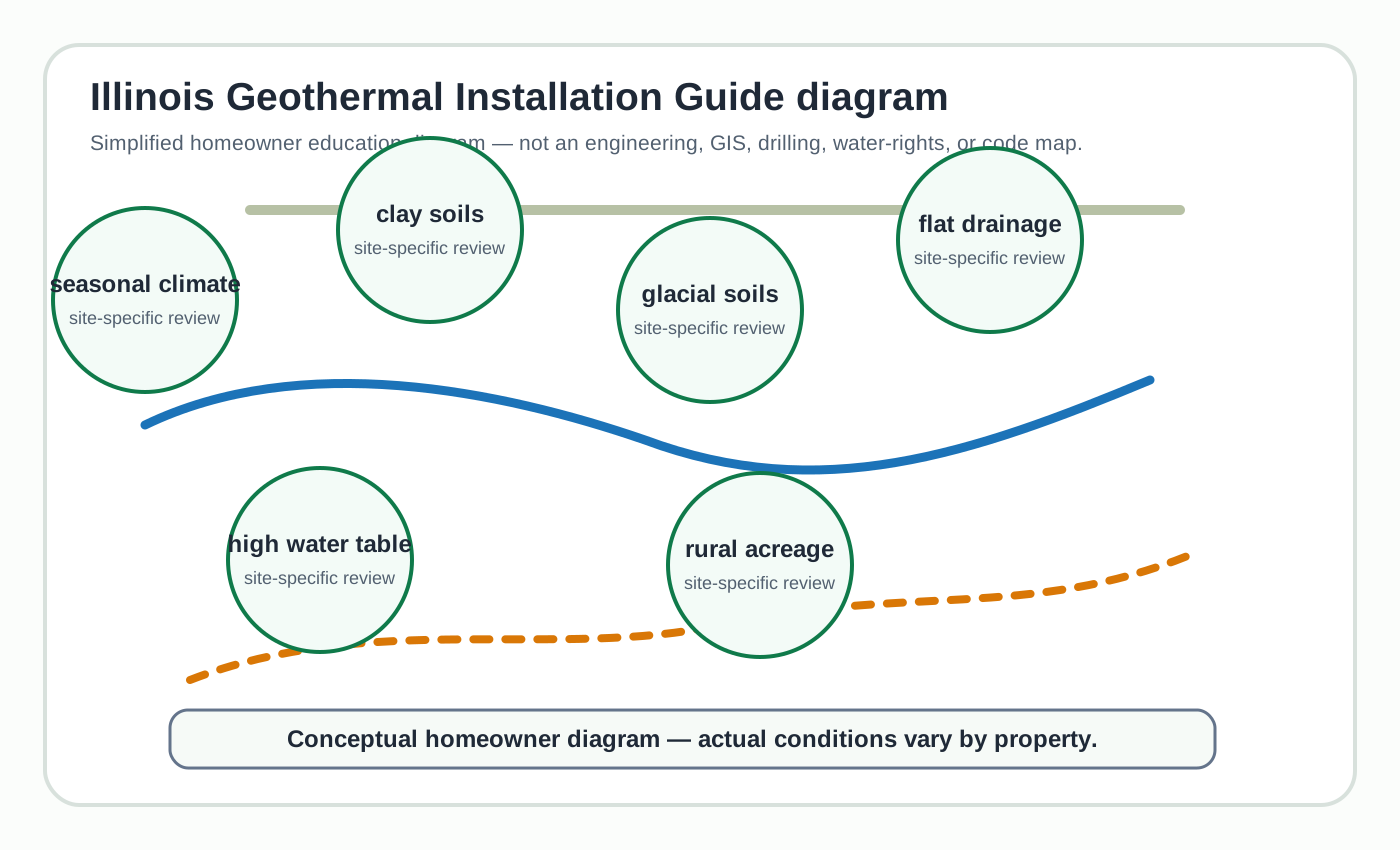
This diagram highlights the broad installation conditions that commonly shape Illinois geothermal planning: seasonal heating and cooling, clay and glacial soils, flat drainage, high water table, urban small lots, rural horizontal loops. It should help a homeowner ask better questions, but it cannot determine whether a particular parcel is suitable for horizontal, vertical, pond/lake, open-loop, or standing-column concepts.
Illinois homeowners should ask how the load calculation reflects humid continental climate with cold winters, hot humid summers, strong seasonal swing, cooling/dehumidification needs, and wind exposure on open sites. The proposal should not rely on square footage or statewide assumptions alone. It should explain room-by-room loads, envelope assumptions, ventilation, ducts or hydronic distribution, controls, backup or auxiliary operation where relevant, and commissioning records.
Comfort is not only a heat-pump capacity question. In hot or humid regions, air movement, dehumidification, sensible cooling, duct leakage, and thermostat settings matter. In cold or mountain regions, heating loads, freeze protection, backup heat, and winter service matter. Coastal and desert regions can have very different operating priorities. A complete proposal explains which of those concerns applies to the actual house.
Site evaluation should address deep glacial soils, clay and silt, flat drainage challenges, high water table or wet sites in some areas, urban/suburban lots, rural acreage, and open-loop groundwater caution. Soil and geology influence trenching, drilling, grout or backfill, bore spacing, pipe routing, restoration, and equipment access. Water conditions influence pond/lake possibilities and open-loop caution. Urban lots add utility, driveway, hardscape, and neighbor-access questions.
Homeowners should ask what is known, what is assumed, and what would cause the loop recommendation to change. A broad state guide can identify common issues, but only site-specific evaluation can tell whether a property is practical for a specific loop design.
The same 13-step process from the national guide applies here, but each step should be tied to the actual home and property.

For Illinois homeowners, project goals and home suitability should be interpreted through humid continental climate with cold winters, hot humid summers, strong seasonal swing, cooling/dehumidification needs, and wind exposure on open sites and deep glacial soils, clay and silt, flat drainage challenges, high water table or wet sites in some areas, urban/suburban lots, rural acreage, and open-loop groundwater caution. The installer should connect this step to the actual home, not to a generic statewide package. Why it matters: Illinois properties can differ by region, lot size, terrain, water availability, access, and indoor distribution, so the wrong assumption can affect comfort, restoration, or serviceability. What homeowners should ask: what evidence from my home and property supports this recommendation, what assumptions remain uncertain, and what would change the design? Red flags include verbal-only answers, no written design basis, one loop type promoted before site review, no discussion of utility locating or restoration, and no commissioning records. A complete proposal usually documents measurements, scope boundaries, exclusions, testing, owner records, and the reasoning behind each decision.

For Illinois homeowners, load calculation and energy analysis should be interpreted through humid continental climate with cold winters, hot humid summers, strong seasonal swing, cooling/dehumidification needs, and wind exposure on open sites and deep glacial soils, clay and silt, flat drainage challenges, high water table or wet sites in some areas, urban/suburban lots, rural acreage, and open-loop groundwater caution. The installer should connect this step to the actual home, not to a generic statewide package. Why it matters: Illinois properties can differ by region, lot size, terrain, water availability, access, and indoor distribution, so the wrong assumption can affect comfort, restoration, or serviceability. What homeowners should ask: what evidence from my home and property supports this recommendation, what assumptions remain uncertain, and what would change the design? Red flags include verbal-only answers, no written design basis, one loop type promoted before site review, no discussion of utility locating or restoration, and no commissioning records. A complete proposal usually documents measurements, scope boundaries, exclusions, testing, owner records, and the reasoning behind each decision.

For Illinois homeowners, site evaluation should be interpreted through humid continental climate with cold winters, hot humid summers, strong seasonal swing, cooling/dehumidification needs, and wind exposure on open sites and deep glacial soils, clay and silt, flat drainage challenges, high water table or wet sites in some areas, urban/suburban lots, rural acreage, and open-loop groundwater caution. The installer should connect this step to the actual home, not to a generic statewide package. Why it matters: Illinois properties can differ by region, lot size, terrain, water availability, access, and indoor distribution, so the wrong assumption can affect comfort, restoration, or serviceability. What homeowners should ask: what evidence from my home and property supports this recommendation, what assumptions remain uncertain, and what would change the design? Red flags include verbal-only answers, no written design basis, one loop type promoted before site review, no discussion of utility locating or restoration, and no commissioning records. A complete proposal usually documents measurements, scope boundaries, exclusions, testing, owner records, and the reasoning behind each decision.

For Illinois homeowners, loop-type screening should be interpreted through humid continental climate with cold winters, hot humid summers, strong seasonal swing, cooling/dehumidification needs, and wind exposure on open sites and deep glacial soils, clay and silt, flat drainage challenges, high water table or wet sites in some areas, urban/suburban lots, rural acreage, and open-loop groundwater caution. The installer should connect this step to the actual home, not to a generic statewide package. Why it matters: Illinois properties can differ by region, lot size, terrain, water availability, access, and indoor distribution, so the wrong assumption can affect comfort, restoration, or serviceability. What homeowners should ask: what evidence from my home and property supports this recommendation, what assumptions remain uncertain, and what would change the design? Red flags include verbal-only answers, no written design basis, one loop type promoted before site review, no discussion of utility locating or restoration, and no commissioning records. A complete proposal usually documents measurements, scope boundaries, exclusions, testing, owner records, and the reasoning behind each decision.

For Illinois homeowners, equipment and system design review should be interpreted through humid continental climate with cold winters, hot humid summers, strong seasonal swing, cooling/dehumidification needs, and wind exposure on open sites and deep glacial soils, clay and silt, flat drainage challenges, high water table or wet sites in some areas, urban/suburban lots, rural acreage, and open-loop groundwater caution. The installer should connect this step to the actual home, not to a generic statewide package. Why it matters: Illinois properties can differ by region, lot size, terrain, water availability, access, and indoor distribution, so the wrong assumption can affect comfort, restoration, or serviceability. What homeowners should ask: what evidence from my home and property supports this recommendation, what assumptions remain uncertain, and what would change the design? Red flags include verbal-only answers, no written design basis, one loop type promoted before site review, no discussion of utility locating or restoration, and no commissioning records. A complete proposal usually documents measurements, scope boundaries, exclusions, testing, owner records, and the reasoning behind each decision.

For Illinois homeowners, proposal review and scope definition should be interpreted through humid continental climate with cold winters, hot humid summers, strong seasonal swing, cooling/dehumidification needs, and wind exposure on open sites and deep glacial soils, clay and silt, flat drainage challenges, high water table or wet sites in some areas, urban/suburban lots, rural acreage, and open-loop groundwater caution. The installer should connect this step to the actual home, not to a generic statewide package. Why it matters: Illinois properties can differ by region, lot size, terrain, water availability, access, and indoor distribution, so the wrong assumption can affect comfort, restoration, or serviceability. What homeowners should ask: what evidence from my home and property supports this recommendation, what assumptions remain uncertain, and what would change the design? Red flags include verbal-only answers, no written design basis, one loop type promoted before site review, no discussion of utility locating or restoration, and no commissioning records. A complete proposal usually documents measurements, scope boundaries, exclusions, testing, owner records, and the reasoning behind each decision.

For Illinois homeowners, permits, utility locating, and schedule planning should be interpreted through humid continental climate with cold winters, hot humid summers, strong seasonal swing, cooling/dehumidification needs, and wind exposure on open sites and deep glacial soils, clay and silt, flat drainage challenges, high water table or wet sites in some areas, urban/suburban lots, rural acreage, and open-loop groundwater caution. The installer should connect this step to the actual home, not to a generic statewide package. Why it matters: Illinois properties can differ by region, lot size, terrain, water availability, access, and indoor distribution, so the wrong assumption can affect comfort, restoration, or serviceability. What homeowners should ask: what evidence from my home and property supports this recommendation, what assumptions remain uncertain, and what would change the design? Red flags include verbal-only answers, no written design basis, one loop type promoted before site review, no discussion of utility locating or restoration, and no commissioning records. A complete proposal usually documents measurements, scope boundaries, exclusions, testing, owner records, and the reasoning behind each decision.

For Illinois homeowners, drilling, trenching, or water-source preparation should be interpreted through humid continental climate with cold winters, hot humid summers, strong seasonal swing, cooling/dehumidification needs, and wind exposure on open sites and deep glacial soils, clay and silt, flat drainage challenges, high water table or wet sites in some areas, urban/suburban lots, rural acreage, and open-loop groundwater caution. The installer should connect this step to the actual home, not to a generic statewide package. Why it matters: Illinois properties can differ by region, lot size, terrain, water availability, access, and indoor distribution, so the wrong assumption can affect comfort, restoration, or serviceability. What homeowners should ask: what evidence from my home and property supports this recommendation, what assumptions remain uncertain, and what would change the design? Red flags include verbal-only answers, no written design basis, one loop type promoted before site review, no discussion of utility locating or restoration, and no commissioning records. A complete proposal usually documents measurements, scope boundaries, exclusions, testing, owner records, and the reasoning behind each decision.

For Illinois homeowners, loop installation and field assembly should be interpreted through humid continental climate with cold winters, hot humid summers, strong seasonal swing, cooling/dehumidification needs, and wind exposure on open sites and deep glacial soils, clay and silt, flat drainage challenges, high water table or wet sites in some areas, urban/suburban lots, rural acreage, and open-loop groundwater caution. The installer should connect this step to the actual home, not to a generic statewide package. Why it matters: Illinois properties can differ by region, lot size, terrain, water availability, access, and indoor distribution, so the wrong assumption can affect comfort, restoration, or serviceability. What homeowners should ask: what evidence from my home and property supports this recommendation, what assumptions remain uncertain, and what would change the design? Red flags include verbal-only answers, no written design basis, one loop type promoted before site review, no discussion of utility locating or restoration, and no commissioning records. A complete proposal usually documents measurements, scope boundaries, exclusions, testing, owner records, and the reasoning behind each decision.

For Illinois homeowners, fusion, flushing, pressure testing, and fluid setup should be interpreted through humid continental climate with cold winters, hot humid summers, strong seasonal swing, cooling/dehumidification needs, and wind exposure on open sites and deep glacial soils, clay and silt, flat drainage challenges, high water table or wet sites in some areas, urban/suburban lots, rural acreage, and open-loop groundwater caution. The installer should connect this step to the actual home, not to a generic statewide package. Why it matters: Illinois properties can differ by region, lot size, terrain, water availability, access, and indoor distribution, so the wrong assumption can affect comfort, restoration, or serviceability. What homeowners should ask: what evidence from my home and property supports this recommendation, what assumptions remain uncertain, and what would change the design? Red flags include verbal-only answers, no written design basis, one loop type promoted before site review, no discussion of utility locating or restoration, and no commissioning records. A complete proposal usually documents measurements, scope boundaries, exclusions, testing, owner records, and the reasoning behind each decision.

For Illinois homeowners, indoor equipment and distribution integration should be interpreted through humid continental climate with cold winters, hot humid summers, strong seasonal swing, cooling/dehumidification needs, and wind exposure on open sites and deep glacial soils, clay and silt, flat drainage challenges, high water table or wet sites in some areas, urban/suburban lots, rural acreage, and open-loop groundwater caution. The installer should connect this step to the actual home, not to a generic statewide package. Why it matters: Illinois properties can differ by region, lot size, terrain, water availability, access, and indoor distribution, so the wrong assumption can affect comfort, restoration, or serviceability. What homeowners should ask: what evidence from my home and property supports this recommendation, what assumptions remain uncertain, and what would change the design? Red flags include verbal-only answers, no written design basis, one loop type promoted before site review, no discussion of utility locating or restoration, and no commissioning records. A complete proposal usually documents measurements, scope boundaries, exclusions, testing, owner records, and the reasoning behind each decision.

For Illinois homeowners, controls, startup, and commissioning should be interpreted through humid continental climate with cold winters, hot humid summers, strong seasonal swing, cooling/dehumidification needs, and wind exposure on open sites and deep glacial soils, clay and silt, flat drainage challenges, high water table or wet sites in some areas, urban/suburban lots, rural acreage, and open-loop groundwater caution. The installer should connect this step to the actual home, not to a generic statewide package. Why it matters: Illinois properties can differ by region, lot size, terrain, water availability, access, and indoor distribution, so the wrong assumption can affect comfort, restoration, or serviceability. What homeowners should ask: what evidence from my home and property supports this recommendation, what assumptions remain uncertain, and what would change the design? Red flags include verbal-only answers, no written design basis, one loop type promoted before site review, no discussion of utility locating or restoration, and no commissioning records. A complete proposal usually documents measurements, scope boundaries, exclusions, testing, owner records, and the reasoning behind each decision.

For Illinois homeowners, homeowner walkthrough, documentation, and maintenance expectations should be interpreted through humid continental climate with cold winters, hot humid summers, strong seasonal swing, cooling/dehumidification needs, and wind exposure on open sites and deep glacial soils, clay and silt, flat drainage challenges, high water table or wet sites in some areas, urban/suburban lots, rural acreage, and open-loop groundwater caution. The installer should connect this step to the actual home, not to a generic statewide package. Why it matters: Illinois properties can differ by region, lot size, terrain, water availability, access, and indoor distribution, so the wrong assumption can affect comfort, restoration, or serviceability. What homeowners should ask: what evidence from my home and property supports this recommendation, what assumptions remain uncertain, and what would change the design? Red flags include verbal-only answers, no written design basis, one loop type promoted before site review, no discussion of utility locating or restoration, and no commissioning records. A complete proposal usually documents measurements, scope boundaries, exclusions, testing, owner records, and the reasoning behind each decision.
No loop type is automatically right for this page. A qualified installer should screen each option against the home, property, water, ground, access, maintenance expectations, and local requirements.

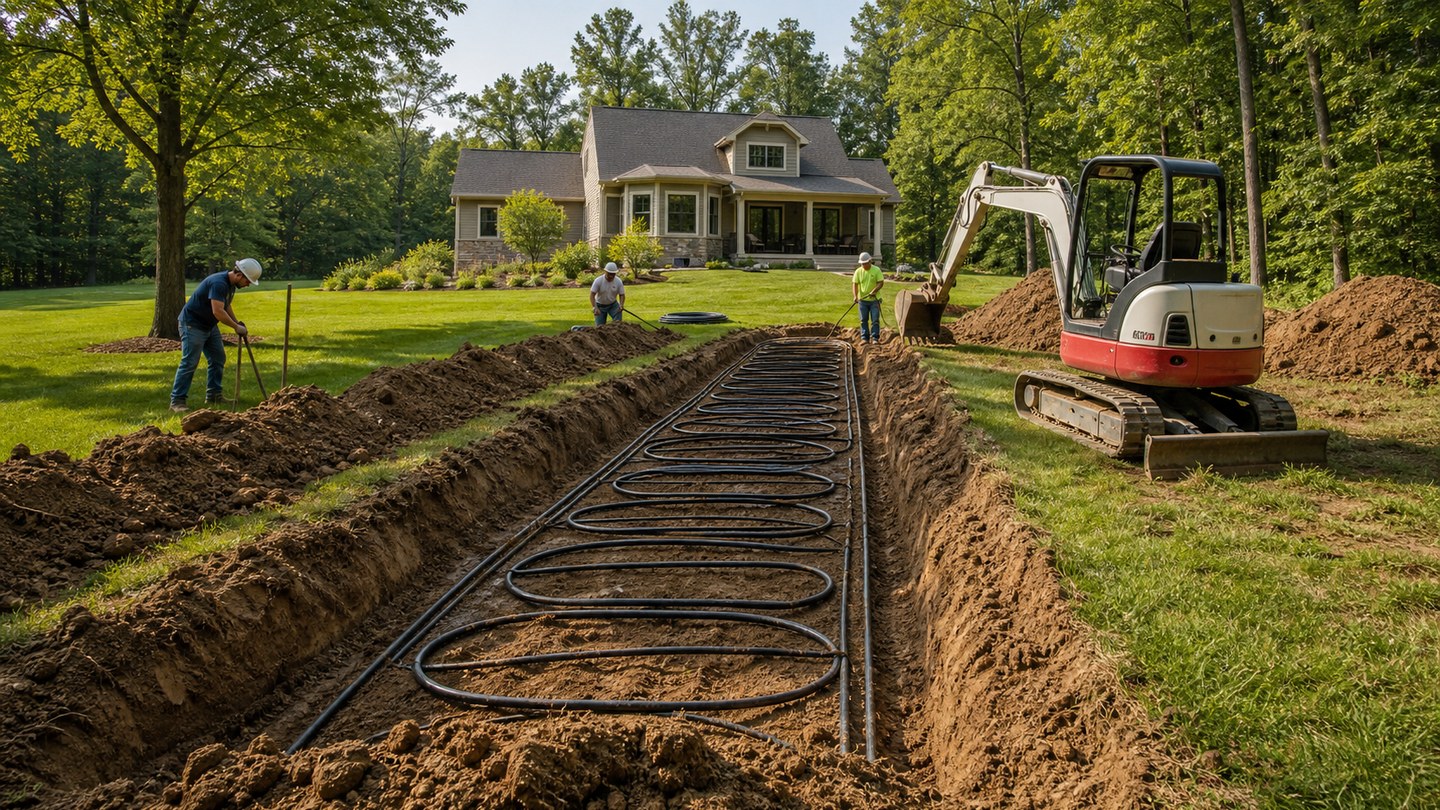
Horizontal closed loops may be considered where usable land, soil, separation from utilities and septic or wells, drainage, access, and restoration make sense. For this Illinois page, homeowners should ask how deep glacial soils, clay and silt, flat drainage challenges, high water table or wet sites in some areas, urban/suburban lots, rural acreage, and open-loop groundwater caution affects trenching, backfill, spacing, and long-term protection. A red flag is choosing horizontal loops from acreage alone without soil, water, and restoration review.

Vertical closed loops may be relevant where the surface footprint is limited, trenching is constrained, or a drilled borefield is more practical. Homeowners should ask about drilling access, geologic assumptions, grout or sealing, bore spacing, utility conflicts, and what happens if subsurface conditions differ from expectations. A red flag is vague drilling responsibility or no as-built borefield record.

Pond or lake closed loops require a suitable water body, stable depth, permissions, routing, protection, and environmental review. The loop is sealed; it is not an open discharge. Homeowners should ask how water level, access, ownership, depth, and maintenance will be verified. A red flag is assuming any pond, lake, or canal-like water feature is automatically suitable.

Open-loop systems require groundwater quantity, water quality, filtration, heat-exchanger protection, discharge or return review, maintenance planning, and local rule review. In water-limited, wet-site, or groundwater-sensitive areas, this should be treated cautiously. A red flag is treating an existing well as automatically suitable without testing and written operating requirements.

Standing-column wells are specialized and regional. They require appropriate geology, water quality, experienced design, and local rule review. They should not be presented as a universal option for Illinois. Homeowners should ask what local evidence supports the concept and what alternatives were considered.

| Proposal item | Complete proposal should include | Why it matters here | Ask | Red flag |
|---|---|---|---|---|
| Load basis | Room-by-room calculation and local assumptions. | humid continental climate with cold winters, hot humid summers, strong seasonal swing, cooling/dehumidification needs, and wind exposure on open sites affects comfort and equipment selection. | What assumptions are documented? | Square-foot sizing. |
| Loop rationale | Why options were accepted or rejected. | deep glacial soils, clay and silt, flat drainage challenges, high water table or wet sites in some areas, urban/suburban lots, rural acreage, and open-loop groundwater caution can change practicality. | Why this loop for this site? | One-size-fits-all loop. |
| Site scope | Access, utilities, soil, water, drilling/trenching, restoration, exclusions. | Outdoor surprises can change schedule and cost responsibility without quoting numbers. | What conditions change scope? | Vague exclusions. |
| Commissioning | Flow, temperatures, controls, startup, backup operation, owner walkthrough. | Records help future service and comfort troubleshooting. | What readings will I receive? | No written startup data. |

Use these related condition pages with this main state guide as they are published in the controlled queue. If a related page is not yet complete when this main page first goes live, it will be available as the queue advances.
Ask the installer to narrate the decision path in plain English: the home load, the site observations, the loop-screening logic, the indoor distribution review, the water or ground uncertainty, the access and restoration plan, the commissioning process, and the records you will receive. For this page, the decision path should specifically address seasonal heating and cooling, clay and glacial soils, flat drainage, high water table, urban small lots, rural horizontal loops. If that condition is not mentioned in the proposal, ask whether it was evaluated or why it is not relevant.
A homeowner does not need proprietary design math, but the proposal should be traceable. You should be able to understand why the installer recommends a horizontal loop, vertical loop, pond/lake loop, open-loop system, or no geothermal project at all. You should also understand what could change the design after further evaluation. A professional answer can include uncertainty. A weak answer often sounds certain because it has skipped the condition-specific work.
Keep your role clear. You are not responsible for drilling, trenching, fusing pipe, wiring equipment, modifying wells, setting controls, or commissioning a heat pump. Your role is to hire qualified professionals, compare written scopes, preserve documentation, ask about local conditions, and avoid proposals that leave critical assumptions unstated. That boundary protects homeowners and keeps technical work with qualified trades.
For Illinois, also ask how future service will work. A geothermal system should come with enough documentation for another qualified technician to understand the design later: loop or borefield map, equipment information, startup readings, pressure-test or flow records, controls notes, warranty boundaries, maintenance expectations, and service contacts. The more unusual the site condition, the more important these records become.
Finally, compare proposals on completeness rather than confident language. The stronger proposal usually explains what was measured, what was assumed, what is excluded, what needs verification, and what records will be delivered. The weaker proposal relies on generic claims, incomplete scope, or a single loop type presented as obvious without connecting it to your home and property.
Find geothermal installers in IllinoisRequest geothermal quotesBrowse geothermal installersView directory map
For the broader installation framework, use the national geothermal installation guide.
It can be practical for some homes, but suitability depends on the home load, indoor distribution, property conditions, loop or water-source options, access, local rules, commissioning, and serviceability. This page is meant to help homeowners ask those questions before signing.
There is no universal loop type. Horizontal, vertical, pond/lake, open-loop, and standing-column concepts should be screened against the actual property, water conditions, soil or rock, usable land, access, and professional design requirements.
Not automatically, but open-loop proposals deserve extra caution. Ask for water quantity, water quality, discharge or return, filtration, heat-exchanger protection, maintenance expectations, and local rule review before treating an existing well as suitable.
Ask for the load summary, site-evaluation notes, loop-type rationale, utility-locate and permit responsibilities, testing records, commissioning readings, controls explanation, as-built loop map, manuals, warranty information, and maintenance expectations.
No. It is a homeowner planning and proposal-comparison guide. Technical design, drilling, excavation, electrical work, water-source work, controls setup, and commissioning should be handled by qualified professionals.
Use this checklist with the existing Illinois guide context. It organizes contractor questions; it does not replace parcel-level investigation or current local requirements.
HOMEOWNER QUESTIONS
Answers for homeowners planning installation, replacement, repair, and maintenance in Illinois.
Begin with a room-by-room load calculation, a site review, and a comparison of documented loop and equipment options. The proposal should connect the home's heating and cooling needs to the ground-side design rather than relying on square footage alone. Apply that review to the documented Illinois site and current local requirements.
Yes. Heating and cooling loads, humidity control, winter design conditions, and seasonal operation all affect equipment selection, loop sizing, airflow, controls, and any auxiliary-heat strategy. For Illinois, use the state guide context—Illinois geothermal installation guide covering cold winters, humid summers, clay and glacial soils, flat drainage, high water table, rural acreage, loop options, installer questions, and proposal red flags.
There is no statewide default. Horizontal, vertical, pond or lake, and carefully evaluated open-loop approaches have different space, geology, water, access, permitting, restoration, and maintenance implications. For Illinois, use the state guide context—Illinois geothermal installation guide covering cold winters, humid summers, clay and glacial soils, flat drainage, high water table, rural acreage, loop options, installer questions, and proposal red flags.
Vertical loops are often evaluated when usable land is limited or trenching would disrupt the site. Drilling access, subsurface conditions, bore spacing, grouting, groundwater protection, and local requirements still need project-specific review. Apply that review to the documented Illinois site and current local requirements.
Horizontal loops may fit properties with adequate accessible land and suitable excavation conditions. The contractor should explain trench depth, spacing, soil handling, drainage, compaction, utility conflicts, and surface restoration. Apply that review to the documented Illinois site and current local requirements.
A water-body loop is site-specific. Ownership, depth, seasonal water conditions, access, environmental rules, anchoring, protection, and heat-exchange design must all be evaluated before it is treated as a viable option. Apply that review to the documented Illinois site and current local requirements.
Only after water quantity, water quality, discharge, well, environmental, and maintenance questions are answered. A water source that appears available is not automatically suitable or permitted for geothermal use. Apply that review to the documented Illinois site and current local requirements.
It provides a defensible basis for equipment capacity, airflow, loop design, and auxiliary heat. Rules of thumb can oversize or undersize the system and can hide duct or envelope problems. Apply that review to the documented Illinois site and current local requirements.
They can change excavation or drilling methods, heat transfer assumptions, groundwater protection, spoils handling, restoration, schedule, and cost. Ask what evidence supports the contractor's ground assumptions. For Illinois, use the state guide context—Illinois geothermal installation guide covering cold winters, humid summers, clay and glacial soils, flat drainage, high water table, rural acreage, loop options, installer questions, and proposal red flags.
The review should address usable land, access, slopes, drainage, utilities, wells, septic components, structures, landscaping, water conditions where relevant, and the likely path between the loop field and mechanical room. For Illinois, use the state guide context—Illinois geothermal installation guide covering cold winters, humid summers, clay and glacial soils, flat drainage, high water table, rural acreage, loop options, installer questions, and proposal red flags.
Often, but the building envelope, electrical service, ducts or distribution system, available mechanical space, and existing comfort problems should be evaluated rather than assumed adequate. Apply that review to the documented Illinois site and current local requirements.
New construction can coordinate the envelope, ducts, electrical work, mechanical room, loop access, grading, and landscaping early. The geothermal design should still be based on the final building plans and loads. Apply that review to the documented Illinois site and current local requirements.
Possibly, if its location, type, size, materials, pressure integrity, flow, antifreeze, records, and compatibility are verified. Reuse should be an engineering decision, not an assumption made to simplify a quote. Apply that review to the documented Illinois site and current local requirements.
It should distinguish equipment-only work from loop, pump, controls, duct, electrical, and auxiliary-heat work; identify what is reused; and state how existing components will be tested and commissioned. Apply that review to the documented Illinois site and current local requirements.
Homeowners should follow the manufacturer's filter and service guidance and have condensate, airflow, electrical, controls, pumps, loop pressure or flow, and auxiliary heat checked as appropriate for the installed system. Apply that review to the documented Illinois site and current local requirements.
Airflow restrictions, duct leakage, control setup, load changes, humidity problems, loop flow, pump issues, sensor faults, auxiliary heat configuration, and equipment faults can all contribute. Diagnosis should use measurements rather than guesses. Apply that review to the documented Illinois site and current local requirements.
Record the code and operating conditions, avoid repeatedly resetting a system without diagnosis, and ask a qualified technician to test the documented fault path and underlying water, airflow, electrical, or control conditions. Apply that review to the documented Illinois site and current local requirements.
Humidity performance depends on loads, airflow, equipment staging, controls, duct conditions, infiltration, and runtime. Ask how the design handles latent load instead of assuming efficient cooling automatically solves every moisture problem. For Illinois, use the state guide context—Illinois geothermal installation guide covering cold winters, humid summers, clay and glacial soils, flat drainage, high water table, rural acreage, loop options, installer questions, and proposal red flags.
Ask when it is expected to operate, how it is sized and controlled, what electrical capacity it requires, and how commissioning will verify that it supports rather than masks the primary system design. Apply that review to the documented Illinois site and current local requirements.
Request startup and commissioning information appropriate to the system, such as airflow, temperatures, loop flow or pressure, pump operation, controls, auxiliary heat, fault history, and homeowner operating guidance. Apply that review to the documented Illinois site and current local requirements.
Normalize scope before comparing price. Check load assumptions, loop design, equipment, ducts, electrical work, permits, excavation or drilling, restoration, commissioning, exclusions, schedule assumptions, warranties, and change-order terms. Apply that review to the documented Illinois site and current local requirements.
Verify the business and trade credentials required for the work, relevant geothermal experience, drilling or excavation responsibility, insurance, references, manufacturer requirements, permitting responsibility, and who will commission the system. For Illinois, use the state guide context—Illinois geothermal installation guide covering cold winters, humid summers, clay and glacial soils, flat drainage, high water table, rural acreage, loop options, installer questions, and proposal red flags.
Responsibility should be written into the contract. Requirements can vary by jurisdiction and project type, so confirm the current process with the applicable local authorities and utility rather than relying on a generic statewide answer. Apply that review to the documented Illinois site and current local requirements.
No. Eligibility, amounts, dates, documentation, and funding can change. Use current official program and tax sources, keep dated records, and do not let an incentive claim replace an otherwise sound project evaluation. Apply that review to the documented Illinois site and current local requirements.
Keep contracts, permits, load calculations, loop drawings, bore or trench records, pressure tests, equipment data, warranties, commissioning results, control settings, maintenance history, and any water-source documentation. Apply that review to the documented Illinois site and current local requirements.
PROPOSAL AND SERVICE CHECKS
Warning signs to investigate before accepting a proposal or repeated repair diagnosis. These are questions to ask, not allegations about any company.
The proposal sizes equipment or the loop from square footage, the old unit, or a quick rule of thumb without showing a defensible load basis. Ask for a written, project-specific answer for the Illinois property.
The contractor declares a universal loop answer without comparing land, access, ground, water, restoration, and local constraints. In Illinois, the proposal should explicitly connect this issue to relevant guide themes such as Clay Soils, Humidity, Drainage, Loop Options.
The proposal does not explain what is known, what is assumed, or how unexpected soil, rock, groundwater, or access conditions will be handled. In Illinois, the proposal should explicitly connect this issue to relevant guide themes such as Clay Soils, Humidity, Drainage, Loop Options.
Wells, septic components, utilities, drainage, foundations, easements, landscaping, or future access are absent from the discussion. Ask for a written, project-specific answer for the Illinois property.
Depths, spacing, materials, grouting or backfill, pressure testing, spoils, dewatering, restoration, and responsibility for changed conditions are unclear. In Illinois, the proposal should explicitly connect this issue to relevant guide themes such as Clay Soils, Humidity, Drainage, Loop Options.
Water conditions, well rules, bore sealing, discharge, contamination pathways, or required approvals are brushed aside without evidence. In Illinois, the proposal should explicitly connect this issue to relevant guide themes such as Clay Soils, Humidity, Drainage, Loop Options.
No one documents sustainable flow, water quality, discharge, scaling or fouling risk, maintenance, and current regulatory requirements. Ask for a written, project-specific answer for the Illinois property.
Depth, seasonal conditions, access, ownership, environmental constraints, anchoring, and protection have not been evaluated. Ask for a written, project-specific answer for the Illinois property.
Existing airflow, static pressure, leakage, return paths, room delivery, and distribution problems are not tested or addressed. Ask for a written, project-specific answer for the Illinois property.
The proposal makes broad comfort claims without discussing latent load, infiltration, airflow, staging, controls, or duct conditions. In Illinois, the proposal should explicitly connect this issue to relevant guide themes such as Clay Soils, Humidity, Drainage, Loop Options.
A larger unit is sold as automatically safer without explaining cycling, airflow, loop demand, comfort, and auxiliary-heat strategy. Ask for a written, project-specific answer for the Illinois property.
The quote includes or excludes backup heat without documenting controls, electrical requirements, expected use, and commissioning. Ask for a written, project-specific answer for the Illinois property.
No records, integrity testing, flow checks, fluid evaluation, sizing review, or compatibility analysis support reuse. Ask for a written, project-specific answer for the Illinois property.
The contractor does not clearly identify which pumps, controls, ducts, loop components, electrical work, and accessories remain. Ask for a written, project-specific answer for the Illinois property.
A recurring alarm is cleared without testing the documented airflow, water-side, electrical, sensor, or control causes. Ask for a written, project-specific answer for the Illinois property.
Pressure or fluid problems are treated as routine maintenance while the source and system condition remain unknown. Ask for a written, project-specific answer for the Illinois property.
The contractor will not provide appropriate startup measurements, settings, functional checks, and homeowner guidance. Ask for a written, project-specific answer for the Illinois property.
The sales case relies on a fixed percentage or payback without dated energy prices, building assumptions, operating behavior, financing, and a clear calculation method. Ask for a written, project-specific answer for the Illinois property.
A temporary tax, utility, or state program is quoted without an official current source, date, eligibility conditions, or documentation requirements. Ask for a written, project-specific answer for the Illinois property.
The contract does not identify who confirms current building, electrical, mechanical, drilling, water, environmental, or local requirements. In Illinois, the proposal should explicitly connect this issue to relevant guide themes such as Clay Soils, Humidity, Drainage, Loop Options.
It is unclear which company and qualified people will design, drill, excavate, wire, connect, start, and service the system. Ask for a written, project-specific answer for the Illinois property.
Large parts of drilling, excavation, electrical, duct, restoration, controls, or disposal scope can change price without defined triggers. Ask for a written, project-specific answer for the Illinois property.
Equipment, labor, loop, drilling, pump, controls, and transfer terms are not provided in writing or tied to responsible parties. Ask for a written, project-specific answer for the Illinois property.
The seller cannot explain who diagnoses the system after installation, what records are retained, or how warranty and emergency calls are handled. Ask for a written, project-specific answer for the Illinois property.
The homeowner is rushed before receiving the load basis, site assumptions, complete scope, exclusions, credentials, references, and written terms. Ask for a written, project-specific answer for the Illinois property.
STATE PLANNING GUIDE
Homeowner-focused Illinois geothermal installation guide covering cold winters, humid summers, clay and glacial soils, flat drainage, high water table, rural acreage, loop options, installer questions, and proposal red flags. These statewide themes are a planning framework, not a conclusion about a particular parcel. A qualified professional still needs to evaluate the home, ground, access, utilities, water conditions where relevant, and current local requirements.
Start a Illinois project with the building loads. A room-by-room calculation should reflect the actual envelope, windows, infiltration, occupancy, ventilation, ducts or other distribution, and local design weather. That load basis should connect to equipment capacity, airflow, loop design, pumping, controls, and any auxiliary heat. Replacing the old unit with the same nominal size or applying a square-foot rule does not document those relationships.
The validated Illinois guides emphasize Clay Soils, Humidity, Drainage, Loop Options. Those conditions can vary within the state and even across one property. Proposals should state what the contractor observed, what records or local experience support the assumptions, what remains unknown, and how changed subsurface or access conditions will be priced and managed.
Loop selection in Illinois should compare horizontal, vertical, water-body, and any proposed open-loop approach on the same decision sheet. Usable area, drilling or trenching access, thermal assumptions, groundwater protection, wells and septic systems, utilities, drainage, restoration, maintenance, and current permitting all matter. A loop type should not be selected from state name or lot size alone.
Existing homes in Illinois also need an indoor-system review. Duct leakage, restrictive returns, poor room airflow, insulation gaps, electrical capacity, condensate handling, controls, and mechanical-room access can affect comfort and project scope. Correcting a ground-side design cannot compensate for every unresolved building or distribution problem.
For replacements, document the existing loop before deciding to reuse it. Useful evidence includes loop layout and size, materials, pressure or integrity results, flow and pumping information, antifreeze condition where applicable, past service records, and compatibility with the proposed equipment. The contract should distinguish reused components from new work and identify who accepts responsibility for each.
Site access and restoration deserve their own Illinois planning conversation. The crew may need room for drilling or excavation equipment, soil or rock handling, delivery, fusion work, pressure testing, and a protected route to the building. Ask how weather, slopes, wet ground, pavement, mature landscaping, fences, neighboring property, and buried infrastructure could change access or restoration. A drawing should identify the proposed loop area and known conflicts, while the contract should explain who marks utilities, who repairs disturbed surfaces, and what happens when concealed conditions differ from the proposal.
A complete Illinois proposal should make drilling or excavation, loop materials, equipment, pumps, controls, ducts, electrical work, permits, disposal, landscaping or pavement restoration, startup, commissioning, warranties, exclusions, and change-order triggers visible. Comparing normalized scopes is more useful than comparing headline prices that include different work.
Operating performance should be reviewed as a system rather than as one appliance rating. Thermostat strategy, staging, airflow, loop temperatures and flow, pumping energy, auxiliary heat, ventilation, humidity, household schedules, and energy prices can all affect what the homeowner observes. Ask the contractor which measurements will establish a startup baseline and which trends or fault conditions should trigger service. Avoid promises of a fixed savings percentage unless the assumptions, comparison fuel, rates, building condition, and calculation date are documented.
Repair diagnosis in Illinois should separate indoor equipment, distribution, controls, electrical supply, pumping, and ground-loop causes. A recurring code or comfort complaint is not proof that the heat pump, loop, or thermostat alone has failed. Useful service records include the reported symptoms, fault history, measured airflow, entering and leaving water temperatures, loop flow or pressure, electrical readings, control calls, and the corrective action. Repeated resets, fluid additions, or parts replacement without identifying the underlying condition are reasons to request a more complete diagnosis.
At turnover, request the load calculation, final loop drawing, bore or trench records, pressure tests, equipment data, control settings, and appropriate commissioning measurements. Keep permits, warranties, and maintenance history together. These records help future technicians distinguish equipment, loop, airflow, pumping, electrical, and control problems instead of troubleshooting by repeated part replacement.
Permits, utility programs, rebates, and tax provisions can change. Confirm current requirements and eligibility with the responsible local authority, utility, or official program source at the time of the project. A dated official source can inform planning, but it does not establish that a specific home or installation qualifies.
VALIDATED LOCAL RESOURCES
These existing, validated local guides provide the detailed state context used on this directory page.